Habits · 7 min read
Why Dota 2 Is Engineered to Make You Feel Like Quitting Is Impossible
It is not a coincidence that stopping feels harder than starting. The game is built around variable reward loops, social obligation, and identity attachment. Here is exactly how it works, and why understanding it is the first step to breaking free.
Contents7 sections
You have probably told yourself "just one more game" more times than you can count. You meant it every time. So why does closing the client feel like fighting gravity? The honest answer is uncomfortable: it's not a willpower problem. The game is doing exactly what it was designed to do, and you are responding exactly the way anyone would respond to that design.
Understanding the machine does not instantly free you from it. But you cannot dismantle something you cannot see. So let us look at the four mechanisms that make Dota 2, and games built like it, feel impossible to walk away from.
This is not a personal failing. Studios employ whole teams whose job is to make their game as hard to put down as possible, and they are very good at it. The pull you feel is engineered, not invented by you.
The variable reward loop
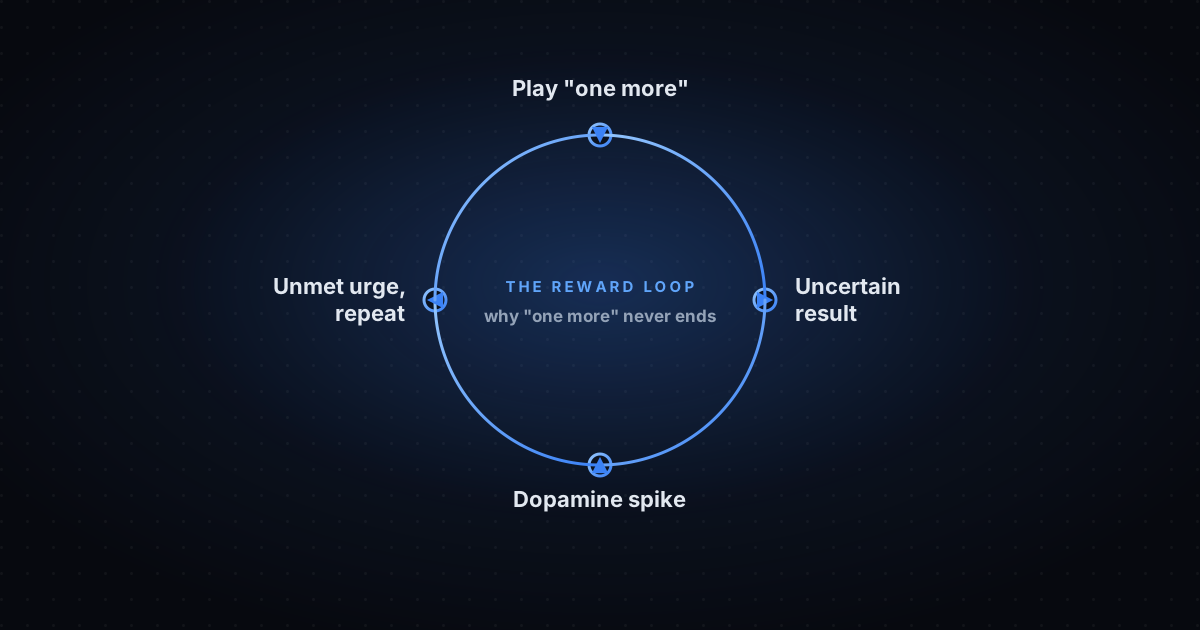
Slot machines and Dota share a core mechanic: unpredictable rewards. If every match gave you the same, predictable outcome, you would get bored and log off. Instead, you never quite know what the next game holds: a smurf who ruins it, a comeback that feels heroic, a teammate who flames you, a perfect team fight. That uncertainty is the point.
You feel the strongest pull not when you win, but in anticipation of a reward that might come. Unpredictable rewards drive far more of that anticipation than reliable ones. So the "one more game" urge is strongest right after a loss, because you are chasing the win you did not get. The loop is self-refueling.
The urge to play one more is not a sign you enjoyed the last one. It's a sign the last one left the reward unresolved.
That is not just a nice line, it is close to how the underlying system actually works. Decades of research from Kent Berridge and Terry Robinson at the University of Michigan draw a hard line between wanting and liking. Wanting, the pull toward a reward, is a large, robust system triggered hardest by cues. Liking, the actual pleasure you get when the reward arrives, runs on smaller, more fragile machinery entirely.
The two can come apart completely. You can want something intensely and enjoy it very little, which is the single best description of a 2am Dota session most people will ever read. If you have ever finished a night of gaming feeling worse than when you started, and queued again anyway, you were not being irrational. You were feeling wanting without liking, exactly as the system is built to produce it. That split is also the reason games stop being fun long before you stop playing them.
Sunk cost, built into your account
Every hour you have played is stored and displayed back to you, down to the hours on record on your Steam profile. Your MMR, your behavior score, your hero mastery, your rare items, your rank at the end of the season. The game quietly turns time into a possession, and people do not walk away from possessions.
This is the sunk cost fallacy wearing a progress bar. "I have put thousands of hours in, I can't stop now" feels like logic. It is not. Hal Arkes and Catherine Blumer named this effect in a 1985 paper in Organizational Behavior and Human Decision Processes, running experiment after experiment showing the same thing: once people have sunk money or effort into something, they keep going even when carrying on is clearly the worse choice. Not because they are bad at maths, but because abandoning it means admitting the investment was wasted.
Dota did not invent that bias. It just built an interface for it. The hours are already gone whether you keep playing or not. The rank does not pay rent, repair a relationship, or move your life forward. But it is displayed to you like an asset, and quitting feels like throwing it away.
Social obligation: the queue that waits for you
Single-player games end. Dota does not, because your friends are online and the party invite is already blinking. Leaving is no longer a decision about a game. It is a decision to let people down. That reframing is deliberate and powerful.
- The stack needs a fifth, and you are the reliable one.
- Someone is mid-climb and you promised to duo.
- Logging off feels like abandoning the group mid-conversation.
None of these are really about Dota. They are about belonging, one of the strongest drives we have. The game borrows that drive and points it back at the queue. For a lot of people, the friendships inside the game are real, which makes this the hardest hook of all to name out loud.
Some games formalise this hook instead of leaving it to chance. In an MMO the obligation is a calendar entry with nineteen other names on it, which is why quitting World of Warcraft turns out to be less about the game than about cancelling a set of appointments. The mechanism is the same one described here, just written down and given a start time.
Identity: when the game becomes who you are
The deepest hook is not on your screen. It is in how you describe yourself. Somewhere along the way, "I play Dota" quietly became "I am a Dota player." Your rank became a measure of you. Your hero pool became a personality. Quitting stops feeling like changing a habit and starts feeling like erasing a part of yourself.
This is why advice like "just uninstall it" bounces off. You are not only removing a program. You are being asked to become a different person, with no clear picture of who that person is yet. Of course you resist. Anyone would.
Why willpower keeps losing
Now stack them: an unpredictable reward that spikes hardest after a loss, a stored record of your invested time, a social group that expects you online, and an identity built around the game. That is four systems pulling in the same direction, engineered by people whose job is to maximize the time you spend playing.
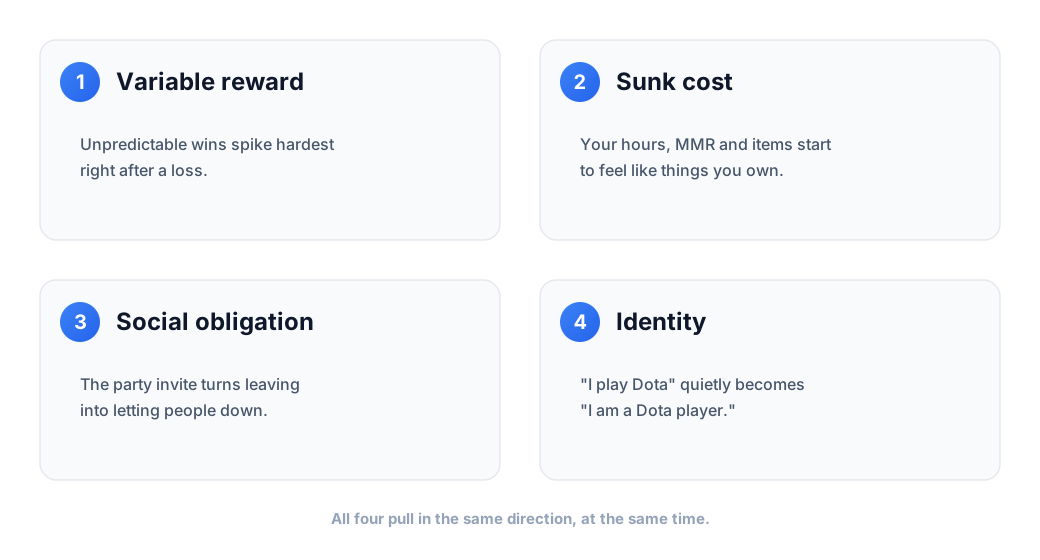
Against all of that, willpower is a single, exhaustible resource. Trying to out-willpower a system built by a team of designers is like trying to empty a bathtub with a spoon while the tap runs full. You are not weak. You are outnumbered.
There is a deeper reason willpower is the wrong tool, though. The USC psychologist Wendy Wood has spent her career measuring how much of daily life is actually decided in the moment, and the answer is: much less than we assume. Her diary studies found that roughly 43 percent of what people do each day is repeated in the same context, usually while they are thinking about something else entirely.
That is the part people miss. Opening the client after work is not a decision you are losing an argument about. Most nights it is not a decision at all. It is a cue firing in a familiar place at a familiar time, and your reasoning arrives afterwards to explain what you were already doing. Willpower is aimed at a choice point that, on most evenings, never actually happens.
What actually works
If willpower is the wrong tool, what is the right one? Changing the environment and the loop, not just white-knuckling the urge. A few principles that hold up:
- 01
Break the loop, not the willpower. Add friction between you and the client: log out fully, remove it from the launch bar, make starting a game a five-step decision instead of one click.
- 02
Replace the reward, do not just remove it. The loop leaves a hole. Fill the evening with something that also gives feedback and progress: training, a project, anything that moves a needle you can see.
- 03
Rebuild identity on purpose. Decide who you are becoming and give it a name before you quit, so stopping is a step toward something, not just a loss.
- 04
Make progress visible. The social pull that keeps you in the queue can work in reverse when your streak, rating, and daily step are tracked somewhere you actually see them.
These principles are general on purpose, because the same machine runs in every competitive game. If you want to see them made concrete for one specific title, we walked through the revenge queue and the reinstall trap in a step by step guide to quitting Valorant, the endless ranked ladder in how to quit League of Legends, the case economy and inventory that make quitting CS2 a three-part problem, and the packs and annual wipe behind quitting EA FC and Ultimate Team.
That last point is what Gaming Reset is built to do. Your answers about your own habit become a weekly routine of small missions, and a Windows app that steps in when a game opens measures what you actually play and keeps the record where you can see it. It does not make the four hooks go away. It means you are no longer the only thing standing against them.
None of this means Dota is a bad game, or that the years you gave it were wasted. It's a genuinely brilliant piece of design, and that is precisely the problem: brilliant design is hard to leave. The people who built these systems were not careless about it. They were extremely good at their jobs.
So stop asking why you can't just stop. You already have the answer, and it was never about your character. The better question is the one the machine is built to keep you from asking: if the next thousand hours went the same way as the last thousand, would that be a life you'd choose on purpose?
Frequently asked questions
Why is Dota 2 so hard to quit?
Because it stacks four reinforcing systems at once: variable rewards that spike hardest after a loss, the sunk cost of your stored hours and MMR, the social pull of friends waiting in the queue, and an identity built around being a player. Willpower alone is fighting all four at the same time.
Is it normal to find a game this hard to put down?
Yes. Competitive games are deliberately designed to be hard to stop playing, by teams whose job is to maximise your time in them. Finding it hard to walk away is the design working as intended, not a flaw in you.
Does willpower work for cutting back on gaming?
On its own, rarely. Willpower is a single, exhaustible resource, and it is up against a system built by professional designers. What works better is changing your environment and breaking the reward loop, so stopping does not depend on willpower you have already spent.
How do I actually stop playing Dota?
Add friction so starting a game is a five-step decision instead of one click, replace the reward with something that also gives visible progress, rebuild your identity around who you want to become, and track your daily step somewhere you actually see it.