Habits · 7 min read
How Many Hours of Gaming Is Too Much? An Honest Answer
Two hours? Four? The honest answer is that the number matters less than what the hours are costing you. Here is a simpler test than counting hours.
Contents6 sections
You counted your hours this week, the total was higher than you wanted it to be, and now you're here looking for a line in the sand. A number that tells you whether you're fine or whether you have a problem. It's a fair question, and you deserve a real answer instead of a comforting one. So here it is: the number matters far less than almost everyone thinks.
You have probably seen "two hours a day" thrown around as the limit. It is a tidy figure, and it is close to useless on its own. Two hours can be a problem for one person and a non-issue for another, and pretending a single number fits everyone does you a disservice when you are actually trying to work out where you stand. So let us do this properly.
The short answer: there is no magic number
Two people can play the same four hours and be in completely different situations: one is unwinding after a good day, the other is hiding from one. Same number on the clock, opposite meaning. That is why a flat hour limit falls apart the moment you apply it to a real life.
A student gaming five hours on a free weekend is not the same as someone gaming five hours by skipping work and sleep to do it. The clock cannot tell those two apart. You can.
It is worth knowing that the researchers who study this most closely have pointedly refused to name a number. The criteria they actually use contain no hour threshold at all. Instead they describe three things: impaired control over your gaming, gaming taking increasing priority over other interests and daily activities, and continuing or escalating despite clear negative consequences.
Read those again, because none of them is a quantity. They are all about control, priority, and consequences. That pattern also has to hold for a long stretch, typically around a year, before anyone treats it as anything more than a rough patch, and only a small minority of people who play games are affected at all. So if the people with the most reason to answer your question with a number refuse to, that should tell you something about the question.
What actually matters more than the total
None of this means hours are irrelevant, and we will get to the extreme end in a moment. But the thing that consistently separates healthy play from harmful play is not the total, it is displacement: what the hours are pushing out of your life. When gaming starts eating your sleep, your movement, your work, and the people around you, the harm shows up regardless of whether you hit some magic threshold.
Which is why when you play tells you more than how long. Three hours on a Saturday afternoon costs you an afternoon. Three hours starting at 11pm costs you an afternoon and the next day, because it comes directly out of your sleep and you pay for it until Tuesday. Identical totals, completely different bills. If the late session is the one you can never get out of, that has a mechanism of its own, which we went through in how to stop playing video games at night.
This is the most measurable cost of the lot. In a survey of 963 gamers presented at a 2016 sleep research conference, players delayed their bedtime on 36 percent of the nights they played, and when they did, the average delay was 101 minutes. More than two thirds said gaming had cost them sleep. Nobody in that survey set out to lose an hour and forty minutes of their night. It just went, one match at a time.
There's a second question hiding in there too: what are the hours for? Playing because you want to and playing because you'd rather not sit with your own evening are two different activities that happen to look identical from outside. Only one of them is really a hobby.
That distinction turns out to carry real weight. A study of roughly 4,300 recreational and esports players tested which motivations actually predict gaming getting out of hand, and found that escapism was the standout predictor in both groups. Competition, fantasy, and skill development showed weak or even negative associations. In other words, playing to win or to get good is not the risky motive. Playing to be somewhere else is.
That is a genuinely useful thing to know about yourself, and it costs nothing to check. Think about the last few times you loaded up a game. Were you moving toward something you wanted, or away from something you did not want to deal with? Nobody else can see the difference. You always can.
The question is not how many hours you play. It's whether you could stop if your life needed you to.
A better test than counting hours
So put the stopwatch down for a second and ask these instead. They tell you far more than a weekly total ever could.
- 01
Have you tried to cut back and failed? Not "meant to", but actually decided on a limit and then blown past it. One slip is nothing. A pattern of broken limits is the clearest signal on this list.
- 02
Does gaming come before sleep and people? Look at what gets sacrificed when there is a conflict. If the answer is consistently your sleep, or someone who wanted your time, gaming is not competing for the leftover hours any more. It is taking them first.
- 03
Do you keep playing when you can see it is hurting you? Missed deadlines, a tired week, an argument you keep having. Knowing the cost and playing anyway is different from not noticing the cost.
- 04
How do you feel on a night you cannot play? Mild disappointment is normal. Genuine restlessness, irritability, or a hollow evening you do not know how to fill is worth paying attention to.
- 05
Do you round the number down when someone asks? Shading the truth about how long you played usually means part of you already knows the real figure is a problem.
- 06
Is the rest of your life getting smaller? The hobbies, the friends outside the game, the plans you used to make. Gaming rarely announces that it is taking over. It just quietly becomes the only thing left on the calendar.
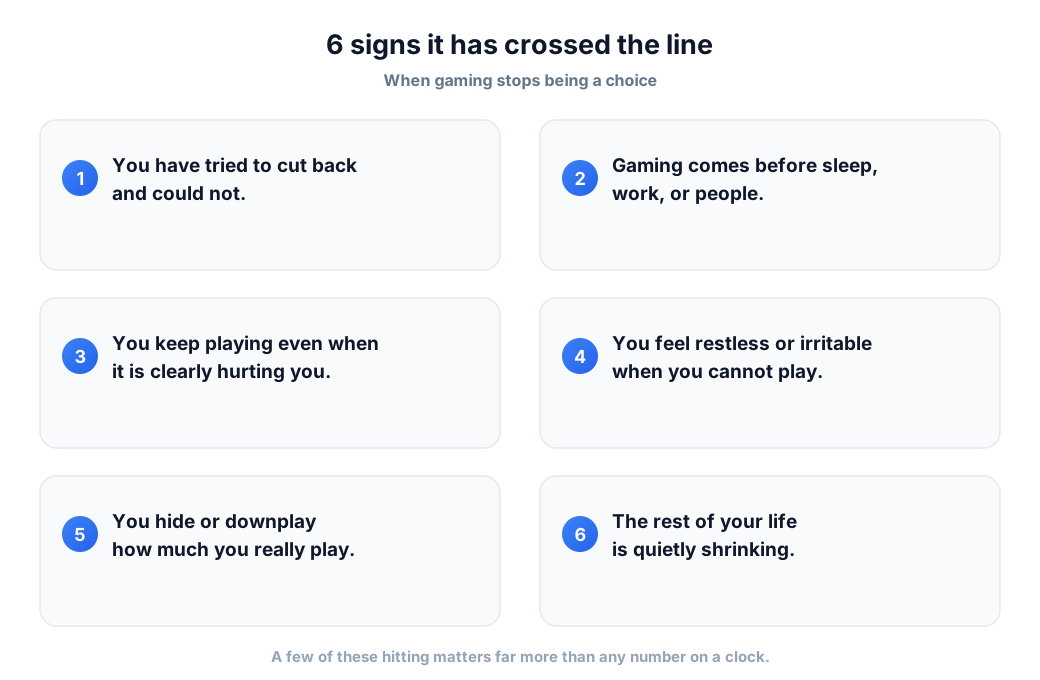
If several of those hit home, the issue was never really the raw hours. It is that gaming has more control over your time than you want it to, and that is a genuinely hard thing to admit. It is also engineered to be that way, which is a big part of why quitting feels so much harder than it should.
Hours still matter at the extremes
To be honest in the other direction too: past a certain point, the number does start to matter on its own, because time is finite. If gaming is taking six, eight, ten hours of your day, it is mathematically eating the hours you would otherwise spend sleeping, earning, moving, or connecting with people. At that level you already know it is costing you. Eight hours a day simply does not leave enough room for a life.
So what do you actually do about it?
If reading this left you a little uneasy, that discomfort is useful information, not something to argue away. Here is what actually helps you get a clear answer, in order.
- 01
Track one honest week. Not to judge yourself, just to see the real number instead of the one you assume. Almost everyone undercounts, often badly, and the gap itself is worth seeing.
- 02
Look at what it is displacing, not just the total. Ask where the hours are coming from. If they are coming out of sleep, work, and the people you care about, that tells you more than the total ever will.
- 03
Try a short, full break. A single clean week off tells you more than any hour count. If you find you genuinely cannot do it, that is your answer, and it is a far more useful one than a number.
That last step is where most people get stuck, because stopping is not a willpower problem, it is a design problem. If one game in particular is the one you cannot put down, we wrote a step by step guide to taking a real break from it that works with how the habit actually operates.
Step one is the part almost everyone means to do and never quite does, partly because every launcher keeps its own count of your hours and none of them adds the others in. It is roughly what Gaming Reset automates. Its Windows app keeps the count for you instead of asking you to remember it, and your answers become a weekly routine of small missions to do instead. You end up with the honest number and something to do about it, rather than just the number.
The number was never really the point. The question worth answering is simpler, and harder: is gaming adding to your life right now, or quietly replacing it? If you already know the answer, you didn't need the stopwatch to tell you.
Frequently asked questions
How many hours of gaming per day is healthy?
There is no single healthy number that fits everyone, and notably the researchers who study this refuse to name an hour threshold at all. The criteria they use are about impaired control, gaming taking priority over other activities, and continuing despite negative consequences. The better test is impact: gaming is generally fine as long as it does not crowd out sleep, work, movement, and relationships.
Is 4 hours of gaming a day too much?
It depends entirely on what those four hours are displacing. Four hours on a day off with everything else handled is very different from four hours that eat into your sleep and responsibilities. Ask what the hours are costing you, not just how many there are.
Is gaming 8 hours a day bad?
At that level the number itself starts to matter, because time is finite. Eight hours a day leaves very little room for sleep, work, and relationships, so it is very likely costing you things you care about.
How do I know if I game too much?
The clearest signal is not hours, it is control. Have you tried to cut back and failed, do you keep playing despite clear downsides, and does gaming come before sleep, work, and people? Those markers matter far more than a weekly total.