Habits · 9 min read
What to Do Instead of Gaming (When Nothing Else Sounds Fun)
You have read the lists. Running, reading, learning guitar. None of it sounds remotely appealing, and that is not because you are broken. It is because a hobby list is the wrong tool. Here is the question to ask first.
Contents8 sections
You've read the lists. Take up running. Learn guitar. Read more. Try painting. And every single suggestion lands with the same dull thud, because none of it sounds remotely like something you want to do on a Tuesday night. So you conclude that you're the problem, that gaming broke your ability to enjoy things. That is not what happened.
The hobby lists fail for a structural reason: they are answering the wrong question. They tell you what other people enjoy. They never ask what the game was actually doing for you, which is the only thing that determines whether a replacement has a chance of sticking.
Why hobby lists do not work
A game is not one activity. It is a bundle of several things delivered at once, reliably, on demand, with no travel and no scheduling. Competitive gaming hands you measurable progress, social contact, total control over your own time, and a difficulty level tuned to sit just past your current ability. Very few things in ordinary life bundle all of that together, which is why swapping in one generic hobby feels so thin by comparison.
When someone tells you to take up reading, they are offering you one thread from a rope. Of course it feels inadequate. It is inadequate, at least as a straight swap, and noticing that is a sign your judgement is working rather than a sign you are past saving.
What games are actually giving you
The most useful research here has nothing to do with quitting at all. In 2006, Richard Ryan, Scott Rigby and Andrew Przybylski published four studies on why games are motivating at all, using self-determination theory. They found that games hold people through three basic psychological needs, and that satisfying those needs predicted both enjoyment and how much players kept playing.
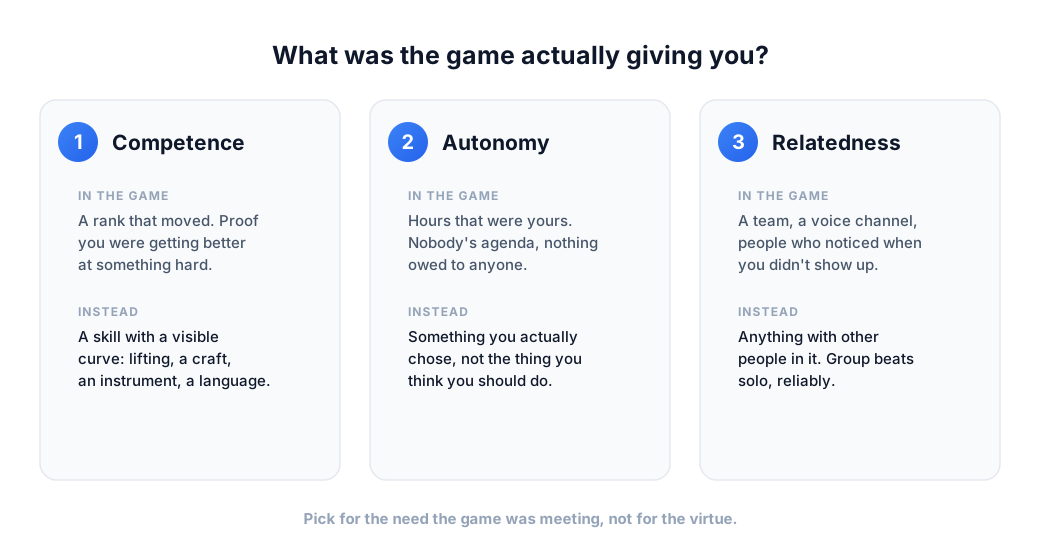
The three are competence, the feeling of getting better at something difficult; autonomy, the feeling that your choices are genuinely your own; and relatedness, the feeling of being connected to other people. Notably, the same research linked need satisfaction to higher vitality, self-esteem and positive mood. Games were not making people worse. They were meeting real needs, efficiently, which is precisely why they are hard to give up.
The game was not a waste of time. It was doing a job. Fire it without a replacement and the job does not disappear, it just goes unfilled.
This reframes the whole problem. You are not looking for something fun. You are looking for something that fills whichever of those three the game was carrying hardest for you. And they are not equally weighted for everyone, which is exactly why one person quits into the gym and thrives while another tries the same thing and is back on ranked within a fortnight.
Work out which need you are actually replacing
Think about your last few months of playing, and be honest about which of these hits hardest.
- 01
Competence. The rank mattered. You watched replays, thought about improving, felt genuinely good when the number moved. If the game had no progression at all you would have played far less. What you are missing is the sense of getting measurably better at something hard.
- 02
Autonomy. The appeal was that those hours were yours. No boss, no obligations, nobody needing anything. You often played after the most demanding parts of your day, and the point was less the game than that nobody could reach you inside it.
- 03
Relatedness. You mostly played with the same people. Solo queue was tolerable at best. If the group stopped playing tomorrow you would probably stop too, because the game was mainly the venue where you saw your friends.
Most people find one dominant and one secondary. That pairing is your actual brief. It is also why generic advice misfires so badly: telling a relatedness player to take up solo running is asking them to replace their friends with cardio, and then blaming them when it does not take.
Matching the replacement to the need
Once you know which need you are filling, the options narrow usefully.
If it is competence, you need something with a visible curve. Not a pleasant pastime, an actual measurable one: strength training, an instrument, a language, a craft where this month's work is plainly better than last month's. The critical feature is feedback you cannot argue with. Reading rarely works for competence players, because there is no scoreboard, which is also why it is the most commonly recommended and most commonly abandoned suggestion on every list.
If it is autonomy, the trap is replacing a game with an obligation. A rigid new schedule of self-improvement is not a substitute for the one part of your day nobody could claim. You need something genuinely chosen and genuinely yours, and it is allowed to be unproductive. Walking with no route, cooking something slowly, building something pointless. The need is unclaimed time, not achievement, and stacking achievements into it recreates the exact pressure you were escaping.
If it is relatedness, the replacement has to have people in it, and the evidence here is unusually direct. A controlled trial of 96 college students who were on their phones too much compared group basketball against a solo exercise practice. Both helped, but the group activity produced the larger drop in phone use and in loneliness. The researchers put it down to the social element rather than the exercise itself.
That was smartphone use rather than gaming, so hold it loosely. But it points the same way as common sense: a team sport, a class, a climbing gym, anything with a fixed time and other humans expecting you, will beat the solo equivalent for a relatedness player almost every time. The mechanism that kept you queuing, other people counting on you, is the same one that will keep you turning up.
This matters most if your gaming came with a roster attached. Leaving a raid team frees two or three fixed evenings a week and removes the group you saw most reliably, both at once, which is why quitting an MMO like World of Warcraft fails so often when the plan is only subtraction. Put people into one of those evenings before it arrives empty.
The one case where no hobby will fix it
There is a fourth motive that does not belong on that list, because it is not a need any replacement can meet. When thousands of recreational and esports players were asked why they played, the answer that tracked hardest with gaming getting out of hand was escape. Competing, immersion and chasing skill did not. Those either barely registered or pointed the other way entirely.
If you were playing mainly to be somewhere other than your own life, no hobby will hold. You will start the gym, or the guitar, or the course, and drop it in three weeks, and conclude that you lack discipline. What actually happened is that you swapped the escape hatch without touching what you were escaping. The new activity does not fail because it was the wrong hobby. It fails because it was never the problem being solved.
That is not a reason to skip the replacement. It is a reason to be honest that the replacement is the smaller half of the job, and that the other half is whatever you would rather not look at directly. Naming that to one person you trust does more than any activity on any list.
How long before it stops feeling forced
Expect it to feel like effort for a while, and do not read that as failure. Researchers at UCL tracked 96 people building a new daily habit and found the median time to reach near-automatic behaviour was 66 days, with a range from 18 to 254. The twenty one day figure everyone repeats is not in the data.
The more useful finding from the same study is this: missing a single day did not measurably damage the habit forming process. One skipped session is not a failure and does not reset anything. Almost everyone who abandons a replacement does it on the back of one missed day plus the story they tell themselves about what that missed day proves.
So the comparison to avoid is the one your brain will keep offering: new hobby on day four versus gaming at year six. Of course the game wins, it has a six year head start on being good at holding you. The honest comparison is against the same activity a few months in, and you cannot make it until you get there.
A realistic way to start
- 01
Pick for the need, not the virtue. Run your shortlist against whichever need came out dominant. If a suggestion does not serve it, it does not matter how good it is for you, it will not survive contact with a bad Tuesday.
- 02
Put it in the slot the game occupied. Same hours, same trigger point. The cue that used to launch the client needs somewhere to go, and an unscheduled intention loses to a familiar cue every time.
- 03
Choose something with people in it if you can. It is the strongest single predictor of turning up, and it covers the friendships the game was quietly providing.
- 04
Give it eight weeks before you judge it. That is roughly what the habit research suggests, and it is far longer than the three weeks most people allow before deciding they are just not a gym person.
- 05
Expect boredom early and plan for it, not against it. The flatness in week one is normal and is not evidence you picked wrong. It is what the absence of a highly optimised reward loop feels like from the inside.
If you have not stopped yet and are trying to work out whether you need to, the more useful question is what the hours are displacing, which we covered in how many hours of gaming is too much. And if you have just stopped and the evenings are the hard part, that is the expected shape rather than a bad sign, as we set out in what happens when you stop playing video games.
This is the part Gaming Reset was built for. The plan comes out of your own answers about what you played for and what you want back, not a list of activities that are good for people in general, and it holds the thread through the weeks where none of it has started to feel natural yet. That stretch is normal. It is also where nearly everyone gives up.
The question was never what to do instead of gaming. It was what gaming was doing for you, and where else that can honestly come from. Answer that and the list writes itself. Skip it and no list ever helps, no matter how many times you read one.
Frequently asked questions
What should I do instead of gaming?
Start by identifying which need the game was meeting rather than picking from a hobby list. Research on games and self-determination theory points to three: competence (getting visibly better at something hard), autonomy (time that is genuinely your own), and relatedness (connection with other people). Match the replacement to whichever was dominant for you, because a replacement that serves the wrong need rarely survives more than a few weeks.
Why does nothing seem fun after quitting gaming?
Because a game bundles several rewards at once, on demand, tuned to your skill level, and almost nothing in ordinary life matches that bundle immediately. Comparing a new activity on day four with a game you have played for years is not a fair comparison, and the flatness in the first week or two is the expected result of removing a highly optimised reward loop rather than evidence that you chose wrong. It is worth knowing that the same flatness often shows up inside gaming itself, well before anyone stops.
What hobbies actually replace video games?
It depends on the need. For competence, something with visible progress works best: strength training, an instrument, a language, or a craft where improvement is measurable. For autonomy, something genuinely self-chosen and allowed to be unproductive. For relatedness, anything involving other people at a fixed time, such as a team sport or a class. Group activities tend to outperform solo ones.
How long until a new hobby feels natural?
Longer than most people expect. A UCL study tracking people forming new daily habits found a median of 66 days to reach near-automatic behaviour, with a range from 18 to 254 days. The popular 21 day figure is not supported by that data. The same study found that missing a single day did not measurably harm habit formation.
Why do I keep quitting new hobbies after a few weeks?
Two common reasons. The first is judging too early, since habits typically take a couple of months rather than a couple of weeks to feel automatic. The second is that the hobby is serving the wrong need. If you played mainly to escape something, the replacement will not hold, because it never touched the thing you were escaping. Research on gaming motives points the same way: escape is the motive most associated with gaming getting out of hand.