Habits · 9 min read
What Happens When You Stop Playing Video Games: An Honest Timeline
Restlessness, boredom, and evenings you do not know what to do with. Here is what the research actually says about stopping, what nobody has measured yet, and why the dopamine detox version is wrong.
Contents9 sections
You're thinking about stopping, and before you commit you want to know what you're actually in for. That is a reasonable thing to want, and it is weirdly hard to find an honest answer. Most of what is written about this is either a horror story designed to scare you straight, or a fantasy where you quit on Monday and wake up on Friday with a six pack and a business.
So here is the real version, built on what the research has actually established, with the parts nobody has properly measured labelled as such. It is less dramatic than the horror story and less magical than the fantasy, and it is a lot more useful than either.
The first 48 hours: the urge shows up fast
The single most consistent finding is that the hard part arrives early. In a 2022 study, researchers followed 69 heavy players through a break from gaming and asked when the pull first showed up. Most who felt an urge to play felt it within the first day or two, and only around seven percent reported it first appearing after day three.
This is worth internalising before you start, because it inverts how most people brace themselves. You are not walking into something that builds slowly over weeks. You are walking into something that hits almost immediately and then has nowhere to go but down. Day two is not a preview of what is coming. Day two is close to the worst of it.
What it actually feels like
It is far less exotic than people expect. Researchers reviewing 34 separate studies found the effects of stopping are most consistently just irritability and restlessness. Not tremors. Not anything cinematic. Mostly you are annoyed, twitchy, and unable to settle.
What people describe alongside that is a specific kind of boredom that has a physical quality to it. Evenings feel long in a way they did not before. You pick up your phone without deciding to. You open the folder where the game used to be. Nothing is exactly wrong, and nothing is interesting either, and that flatness is the thing most people find hardest to sit with.
Nobody reinstalls because the cravings were unbearable. They reinstall because Tuesday evening was boring and they had nothing else to put in it.
The dopamine detox story is wrong
Almost every article on this topic tells you the same thing: gaming floods your brain with dopamine, quitting leaves you in a dopamine deficit, and after a few weeks off your receptors reset and normal life feels good again. It is a tidy story. It is also not how any of this works, and believing it will actively mislead you about what you are experiencing.
The clearest correction comes from decades of work by Kent Berridge and Terry Robinson at the University of Michigan, who separated two things everyone else was treating as one: wanting and liking. They found that dopamine drives wanting, the pull toward a reward, especially when triggered by cues. It does not produce liking, the actual pleasure of the reward itself, which runs on entirely different and much smaller systems.
Dopamine is not your happiness supply, so quitting does not drain a tank you then have to refill. What is actually happening is more specific and more manageable: you built a very strong wanting response to a very reliable set of cues. The chair, the time of day, the friend coming online, the end of a work session. Those cues are still firing, and the thing they point at is gone. The same split explains something you may have noticed well before you stopped, which is why the games had stopped being fun while you kept playing anyway.
This matters practically, not just pedantically. If you believe you are in a chemical deficit, the only thing to do is wait it out and hope your brain repairs itself on schedule. If you understand it as cues firing at a missing target, the job becomes obvious: change the cues, and give them something else to point at. One of those framings hands you something to do tonight. The other hands you a countdown.
Week one: the hole where the evenings were
By the end of the first week the sharp edge usually dulls and a different problem takes over: time. Gaming was not only occupying your evenings, it was structuring them. It told you when the night started, what you were doing, and when it ended. Remove it and you do not get a tidy block of free time. You get several hours of unshaped nothing, every single night, which is far more disorienting than people expect.
This is the stretch where the reinstall happens, and it is almost never a dramatic collapse. It is a quiet Tuesday, a mild bad mood, and no particular reason not to. The people who get through it are rarely the ones with more resolve. They are the ones who decided in advance what the evenings were for.
Weeks two to four: sleep first, then everything else
The first clear improvement most people notice is sleep, and it is worth seeing the size of what was being taken. A 2016 survey of 963 gamers found that on more than a third of the nights they played, they went to bed later than they had meant to, by an average of 101 minutes. Two thirds of them said gaming had cost them sleep outright.
Stop, and that time comes back immediately, without any effort or virtue on your part. It is the one benefit that is close to automatic, and it is usually what people report first: not that they feel transformed, but that they are less tired, and that everything else is slightly easier from there. If the nights are the specific part you want back rather than gaming as a whole, that is a narrower problem with its own fix, set out in how to stop playing video games at night.
What does not happen is a personality transplant. Somewhere in the second or third week a lot of people hit a quiet disappointment, because the hours came back and they turned out to be ordinary hours. Quitting removes a problem. It does not install a life. If you were unhappy before and gaming was covering it, you will now be unhappy with better sleep and more free time, which is genuinely a better position to solve it from, but it is not the same thing as being solved.
What the research honestly does not know
Here is the part most articles on this subject leave out. The same review that pinned down irritability and restlessness also concluded that the evidence base here is very underdeveloped, and specifically that studies have not tracked how those effects progress or fade over time.
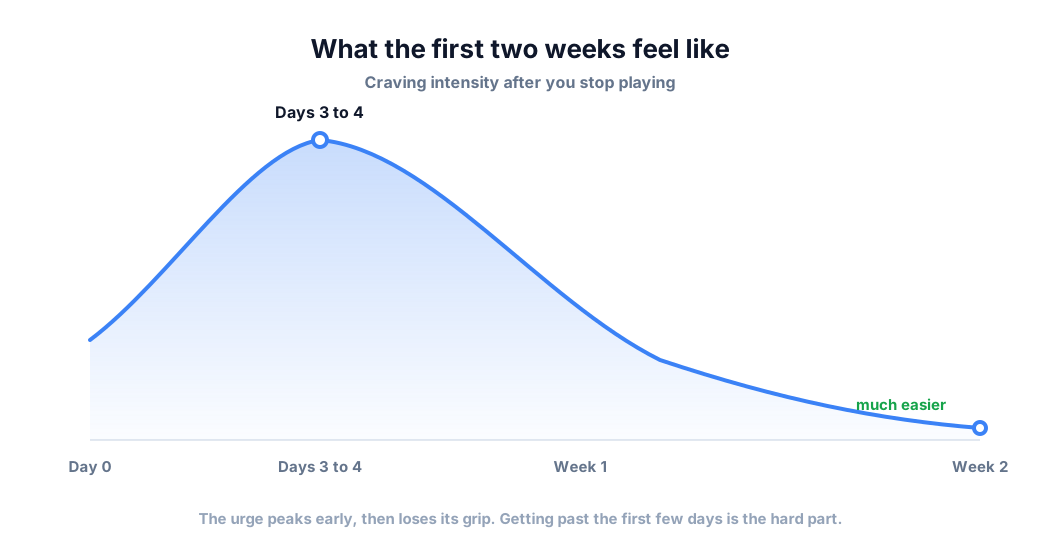
So when you read a confident day by day breakdown promising that day four is the peak and day fourteen is freedom, including the curve at the top of this page, understand what you are looking at. That is the shape people commonly describe, and it is a reasonable expectation. It is not something science has measured and confirmed. Anyone presenting it as established fact is telling you more about their content strategy than about your brain.
What does hold up across both the studies and the anecdotes is the direction: it starts hard, and it gets easier sooner than it feels like it will on day two.
What actually predicts whether it sticks
One thing tells you more about how your break will go than any timeline can, and it is not how many hours you were putting in. It is what you were playing for. Asked exactly that, thousands of recreational and esports players gave answers in which a single motive lined up with gaming getting out of hand, and it was escape. Competing, immersion and improving were weak signals, and in places ran the other way.
Read that as a diagnostic. If you played mainly to compete or to get good at something, stopping is largely a scheduling problem, and it tends to go about as well as you would expect. If you played mainly to be somewhere other than your own life, then the game was doing a job, and removing it without addressing the job is why attempts fail and keep failing. The urge you feel on day nine is not really about the game. It is about whatever the game was covering.
Which points at the thing that actually determines the outcome:
- 01
Decide what the evenings are for before you stop, not after. The empty time is the real difficulty, and it arrives on schedule whether you have a plan or not. Any specific plan beats a vague intention to do something better.
- 02
Change the cues, not just the game. Same chair, same hours, same Discord open in the background is the environment that built the habit. Leaving it intact and relying on resolve is the most common way this fails.
- 03
Replace visible progress with visible progress. Ranked gave you a number that moved. Something else needs to move: a log, a streak, a skill you can see improving. Nothing formal, just something that answers the question of whether today counted.
- 04
Be honest about what the game was for. If it was escape, the break buys you room to deal with what you were escaping. It does not deal with it for you, and pretending otherwise is how month three goes wrong.
If you are still working out whether you need a full break at all, the more useful question is not the raw total but what the hours are displacing, which we went through in how many hours of gaming is too much. And if one specific game is the one you keep coming back to, the mechanics matter, so it is worth reading why competitive games are engineered to keep you hooked before you try again.
When it is more than a break
One thing worth keeping in proportion. Researchers who study this are clear that only a small proportion of people who play games ever reach the point where it is genuinely out of their control, and that the pattern has to hold for a long stretch, normally around a year, before it counts as anything more than an oversized habit.
Most people reading this are nowhere near that. They have a habit that got large and started taking things they wanted back. That is a normal problem with a practical solution. But if stopping repeatedly proves impossible, or if what surfaces when the game is gone is heavier than boredom, that is worth talking to someone you trust about, and it is not a failure of the plan.
For the ordinary version, deciding what the evenings are for is the entire job, and it is far easier to do on a calm Sunday than at 9pm on the Tuesday itself. That is the part Gaming Reset does in advance. Your answers become a weekly routine of small, specific missions, already sitting there when the empty evening arrives, and its Windows app puts them in front of you the moment a game opens.
The honest summary is this. The first two days are the worst and they are survivable. The first week is boring and that is the real risk. The sleep comes back on its own. Nothing else does, and what you build in the space is entirely up to you, which is the difficult part and also the whole point.
Frequently asked questions
What happens when you stop playing video games?
The urge to play usually appears fast. In a 2022 study following people through a break from gaming, most who felt an urge felt it within the first day or two. The most consistently reported effects are irritability and restlessness, followed by a period of boredom as the evenings gaming used to fill open up. Sleep is typically the first thing to improve.
How long does it stay hard after you stop gaming?
Be cautious with precise timelines. A review of 34 studies found the evidence here is underdeveloped and that research has not properly tracked how the effects fade over time. What is clear is that they tend to appear within the first day or two, and both research and personal accounts agree the difficulty is front-loaded rather than building over weeks.
Do you need a dopamine detox to quit gaming?
No, and the underlying idea is mistaken. Research separating wanting from liking shows dopamine drives the pull toward a reward rather than the pleasure of it, so quitting does not drain a supply that needs refilling. What you are actually dealing with is a strong cue-driven wanting response with its target removed. Changing your environment and cues does far more than waiting for a reset that is not happening.
Why do I feel bored and restless after quitting gaming?
Because gaming was structuring your evenings as well as filling them, and restlessness is one of the two most consistently reported effects alongside irritability. The boredom is not a sign something is wrong. It is the predictable result of removing several hours of reliable stimulation without deciding in advance what replaces it.
Will quitting video games make me happier?
It reliably gives you back time and sleep. It does not automatically make you happier. Quitting removes a problem rather than installing a life, and many people hit a flat patch in week two or three when the hours return but turn out to be ordinary hours. If gaming was covering something heavier, that becomes more visible once it is gone, which is uncomfortable but is also the point at which it can be dealt with.
What is the hardest part of quitting gaming?
Not the cravings. Most people go back on an unremarkable evening with nothing planned, rather than during an intense urge. The empty, unstructured time in the first week or two is the real difficulty, which is why deciding what the evenings are for before you stop matters more than resolve.