How to Quit World of Warcraft When You Never Really Left
You have cancelled the subscription before, probably more than once. Then an expansion was announced, the old guild chat woke up, and you were back inside a week. The client was never the thing holding you, which is why deleting it has never been enough.
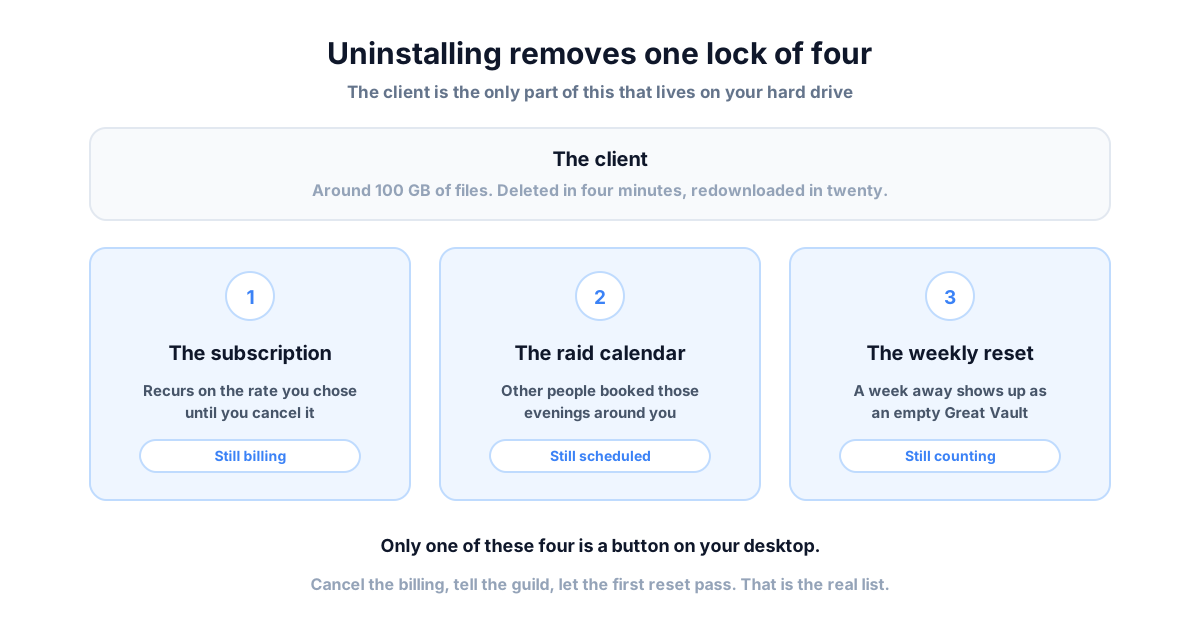
You have quit World of Warcraft before. Probably more than once. You cancelled the subscription, told the guild you were done, maybe even deleted the folder, and for a few months it held. Then a new patch got announced, the old chat woke up, and you were standing in a capital city at eleven at night wondering how that happened again.
Here is the thing almost no quitting guide says out loud. Every other game you leave by walking away from it. This one you leave by ending a billing relationship, a set of appointments with other people, and a weekly schedule that keeps running whether you are there or not. An uninstall touches none of the three. That is why the game has collected you back every time, and why it is set up to do it again on a date you could go and look up right now.
One note before the rest of it. All of this applies to retail World of Warcraft and to Classic, and to whichever seasonal version is current when you read it. The content differs. The parts that actually hold you are the parts every version shares, which is most of the point.
It is the only game you pay rent on
A subscription is a strange thing to defend, and worth looking at directly. In most games the money is spent once, or spent on items. In WoW it buys access by the month, and Blizzard describes the arrangement plainly in its own support pages: a subscription recurs at the rate you chose, monthly or every three, six or twelve months, using your saved payment method, until you pause or cancel it.
Which means there is a number you already know and have probably never said. How many months in the last three years did you pay for and barely log into? That money did not buy playing. It bought the option to play, and the option is the actual product. A game you are still paying for is a game you have not finished arguing with.
Then there is the token, which is worth understanding even if you have never bought one. Blizzard's own announcement sets it out: you buy a WoW Token with real money and sell it for gold through the Auction House, and whoever buys it with gold redeems it for 30 days of game time. Two players, one bill, no cash leaving the second one's account.
The version people say out loud is "I play for free, I pay for it with gold." Read that sentence again with fresh eyes. You are farming to cover a bill. The game did not stop charging you when you started using tokens. It started taking the payment in evenings instead of pounds, which is the more expensive currency and the one you cannot earn more of.
A subscription you keep paying through the months you do not play is not the cost of a hobby. It is a retainer on an identity you have not decided to give up yet.
You have never quit. You have unsubscribed.
This is the structural difference between this game and every other one people write quit guides about. Nothing you built is ever destroyed. Your characters sit there at the level you left them, in the gear you left them in, for as many years as you like. Compare that with the way Ultimate Team wipes your entire club every September, deletes the cards and the coins, and keeps only what you paid for. Warcraft does the opposite. It keeps everything and asks nothing while you are gone.
The game is also comfortable telling you this. Blizzard periodically runs a promotion where, in its own words, it gives all players with inactive accounts full access to the game and all your characters without a subscription for a few days. You have to have had a subscription before to qualify. It is not aimed at new players. It is aimed at you.
So every time you have quit, what you actually did was end a payment. The account did not close. The characters did not go anywhere. There was never a moment where the door shut, only a month where the card was not charged. Naming that is not a criticism of you. It is the most useful sentence on this page, because it means you have never once run the experiment you thought you were running.
The raid night is the lock, and it is not made of loot
Ask someone why they cannot stop and they will talk about the gear, or the alt they are levelling, or how much time they have put in. Watch what actually pulls them back on a Wednesday and it is none of those. It is that nineteen other people have Wednesday in a calendar, and one of them will notice.
There is decent evidence that the social layer is where the grip is. Joel Billieux and colleagues recruited 690 players and, in a study published in Computers in Human Behavior in 2013, matched their stated reasons for playing against eight months of what their characters actually did, pulled from the game's own armory database rather than from self report. Teamwork and competition motives turned out to be the sharpest predictors of fast progression through the game.
The same work is worth citing for the part that cuts the other way, because it is the honest half. Playing a great deal was not, by itself, reliably tied to a negative effect on daily life. Certain motives were, escapism and advancement among them, but sheer hours were not the dividing line. If you play a lot and the rest of your life is genuinely fine, this article is not describing you, and you are allowed to close it.
For everyone else, the mechanism is worth being precise about. You are not choosing between playing and not playing. You are choosing between showing up and letting nine or nineteen people down, which is a completely different decision and a much harder one. The way competitive games manufacture that obligation is deliberate design, not an accident of playing with friends, and knowing that makes it much easier to cancel a commitment without treating it as a betrayal.
The weekly reset turns a week off into a loss
Underneath the raid sits the quieter machinery, and it runs on a clock. The Great Vault fills according to what you completed in a given week, and Blizzard's support pages are blunt about the consequence: if you did not complete any objectives before the weekly reset, there is nothing there to claim, and that is intended behaviour rather than a bug.
Sit with what that does to a week. Skipping a night of a normal game costs you nothing at all. Skipping a week here produces a visible, itemised zero, in a chest that opens on a day you can name. It is the difference between not going to the gym and not filing your timesheet. One is a hobby you did not do, the other is a task you failed to complete, and your nervous system does not treat those the same way.
That is how a game becomes a payroll cycle. You stop playing because you want to and start playing because it is Tuesday, and the two feel almost identical from inside. If your evenings have quietly turned into a list of things to get done before a deadline, the reason games stop being fun while you keep playing them covers exactly that gap, and it is worth reading before you decide the problem is that you have got bored of this one.
Seasons and expansions are a collection schedule
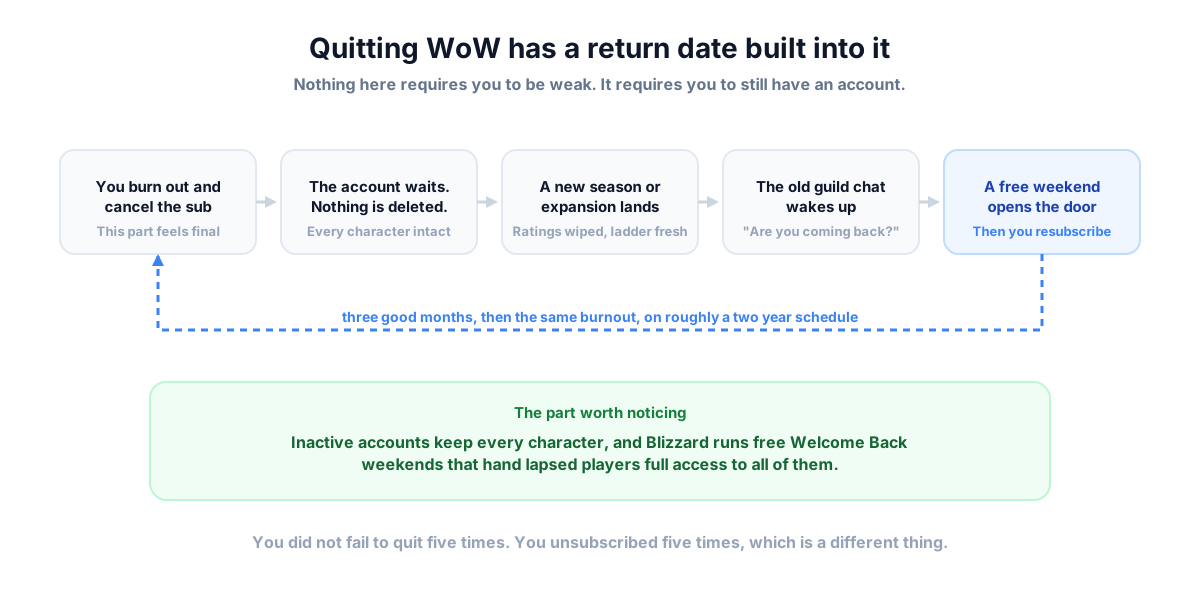
Every season, the ladder empties. When Blizzard laid out the schedule for the second season of its current expansion, the pattern was the usual one: Mythic Plus ratings reset, arena and rated PvP standings reset, a new tier of Great Vault gear becomes available, and the difficulties and raid wings unlock across several weeks rather than all at once.
Read that as a returning World of Warcraft player and it is close to irresistible. Everyone is level again. Nobody is ahead. The thing that made coming back feel hopeless, being a year behind people who never stopped, is deleted on a schedule, and the staggered unlocks mean the first month has a reason to log in every single week. This is a very good way to run a live game. It is also a machine for collecting lapsed players, and you are a lapsed player.
The expansion cycle is the same trick with a longer arm. You leave burnt out, eighteen months pass, an announcement lands, the old chat wakes up, someone says the new one is different, and it genuinely is different, because the content is new. What is never different is the shape of your week afterwards. Three good months, then the same Wednesday, then the same burnout, roughly every two years, for as long as you have had the account.
Why Classic, or "I will just go casual", does not hold
The two most common half measures both fail for the same reason, and it is worth knowing which one you are about to try. Moving to another version keeps the account, the friends, the reset and the ladder, and changes only the scenery. Going casual on retail keeps every single one of them and just removes the part you were best at.
That does not make cutting down the wrong goal. It makes it a goal that needs a different plan from the one you have been using. What the evidence says about playing in moderation is more encouraging than most quitting content admits, with one consistent caveat: a clean break first, then a limit, works far more often than a limit applied to a habit that is still running at full speed.
How to quit World of Warcraft, step by step
- Decide whether you are leaving the game or leaving the raid team, and say which one out loud before you do anything else. They are different projects with different costs, and half the failed attempts are people who never picked. Plenty of people keep a character and lose nothing. Nobody keeps a raid spot and plays casually.
- Cancel the recurring subscription today, and do not pause it. Pausing is a supported, sensible looking option, which is exactly why it is the wrong one here. A pause is a return date you have already agreed to. Cancel it, and let the remaining paid time run out without renewing.
- Tell the guild before you tell yourself, and give the date. Name your last raid night, post it where the roster can see it, and let them fill the spot. Disappearing feels easier and costs more, because an unfinished exit leaves an apology owed, and going back to apologise is a login.
- Leave the guild chat and the Discord servers, not just the game. This is the surface that outlives the client. You can be out of the game for a month and still be reading raid logs, patch notes and roster drama every day, which keeps the whole thing warm and ready.
- Deal with banked game time and tokens deliberately rather than leaving them. Thirty days sitting in the account is an open loop, and open loops get closed on bad evenings. Either use it and be done on a date you set, or write off the value now, out loud, as the price of leaving.
- Uninstall last, and be honest about what it does. It reclaims disk space and adds twenty minutes of friction. It does not close the account, delete a character, or stop a single one of the things above. Treat it as the full stop on the sentence, not the sentence.
- Put something in the raid nights before they arrive. This is the step people skip and it is the one that decides the outcome. Two or three fixed evenings a week are about to come free, at the same time, with the same people missing from them, and an empty Wednesday is the most reliable route back in.
- Write down what you will do when the next expansion is announced, while you are clear-headed and it is still hypothetical. You already know roughly when it is coming. Deciding in advance is not pessimism, it is the one moment where the decision is cheap.
What the first month actually feels like
The first day is usually fine, which surprises people. The first reset day is not, and neither is the first raid night, because those are the moments the calendar reaches for you rather than the other way round. The honest timeline of what happens when you stop covers the general shape: the discomfort is real, it arrives in waves tied to the hours you used to play, and it fades on a scale of weeks rather than months.
Two things are specific to WoW. The first is that your free time arrives in the wrong shape. A raid block is three or four hours, late, twice a week, and an evening that size is genuinely hard to fill with anything that is not another screen. If most of your gaming was already running past midnight, why late night play is so hard to stop is the piece of this that has almost nothing to do with the game itself.
The second is that a decade of characters does not stop existing, and you will feel that as loss rather than relief for a while. It helps to be specific about what you are actually giving up, which is a schedule rather than a collection. Running your real weekly hours through a calculator that turns them into days and weeks makes the trade concrete, and the number is usually the thing that settles the argument. Then put something with other people in it into one of the freed evenings, because replacing the need rather than the activity is what makes the gap close instead of sitting open.
When it is not really about the game
Sometimes the game is the problem and removing it is enough. Sometimes it is where you go when the day has been too much, and then a plan made of cancellations will not hold, because none of it touches the reason. Across surveys of why people play, escape is the motive that lines up most closely with gaming getting out of hand, more so than competition or achievement, and that pattern shows up in the Warcraft-specific research too.
There is a version of this that is specific to long-running online games and worth saying plainly. For some people the guild is not a hook, it is the main place they see other people all week. If that is true for you, then quitting without replacing it is not a plan, it is a subtraction, and it will not survive a bad month. Leave the raid, keep the friendships, and move them somewhere that does not bill you monthly.
Nothing here is professional advice, and when gaming is tangled up with something heavier, talk to someone you trust. But if you have cancelled this subscription three times already and it keeps coming back, the missing piece was probably never willpower. It was that you kept cancelling a payment and calling it a decision.
Frequently asked questions
Why is World of Warcraft so hard to quit compared to other games?
Because three of the four things holding you are outside the game client. The subscription keeps billing until you cancel it, the raid roster is other people planning their week around you, and the weekly reset means a week away produces a visible empty Great Vault rather than nothing at all. Uninstalling removes the files and leaves all three of those running, which is why it has never been enough on its own.
Do my characters get deleted if I stop paying the subscription?
No, and this is the detail that quietly makes quitting harder. An inactive account keeps its characters at the level and in the gear you left them, indefinitely. Blizzard also runs occasional Welcome Back Weekends that give inactive accounts full access to the game and all their characters without a subscription. Nothing you built is ever at risk, so there is no deadline forcing the decision and no penalty for coming back.
Should I pause my subscription or cancel it?
Cancel it. Pausing looks like the responsible middle option and it is the one most likely to fail, because a pause is a return date you have already agreed to and a decision you have deferred rather than made. Cancel the recurring payment, let any remaining paid time run out without renewing it, and treat any banked game time or tokens as spent rather than leaving them sitting in the account as an open loop.
Is switching to Classic instead of retail a good way to cut down?
It rarely works, because it changes the content and keeps the structure. You still have the account, the friends, the guild, a weekly lockout and a ladder to climb, so the shape of your week barely moves. Some people genuinely do want less of the game rather than none of it, which is a legitimate goal, but it needs a clean break first and then a limit, not a sideways move into a different version.
Does playing a lot of WoW mean I have a problem?
Not by itself. In one study of 690 players whose in-game behaviour was tracked for eight months, high involvement was not reliably tied to a negative impact on daily life, while particular motives such as escapism and advancement were. Hours are a poor test on their own. The more useful question is what the hours are displacing, and whether you would be comfortable if the people close to you knew the real total.
How do I handle my guild when I quit World of Warcraft?
Give a date and a last raid night rather than disappearing. Ghosting feels easier in the moment and is the more expensive option, because it leaves an apology owed and going back to make it is a login. Post the date where the roster can see it so your spot gets filled, then leave the guild chat and any Discord servers, since reading raid logs and patch notes every day keeps the habit warm without you noticing.
Ready to break the loop?
A simple daily plan built around how these hooks actually work, tracked in one app on web and mobile. Start free for 3 days.
Start free, 3 days →