Habits · 9 min read
How to Play Video Games in Moderation (And When It Will Not Work)
Most advice treats wanting to cut back rather than quit as denial. It is not. Moderation is a legitimate goal, it just fails for predictable reasons. Here is what the research actually supports.
Contents10 sections
You don't want to quit. You want gaming to stop quietly eating hours you meant to spend on something else, and you would like to keep playing the thing you actually enjoy. That is a completely reasonable position, and most of the internet will treat it as denial.
The two loudest camps are both unhelpful here. One sells moderation as a matter of setting a timer and having a bit of discipline. The other insists that if you are asking the question at all, you are kidding yourself and the only answer is to quit forever. Neither is what the evidence actually shows.
Moderation is a legitimate goal
Start with the thing the quit-forever camp tends to skip. The criteria researchers actually use turn on impaired control, gaming taking priority over other activities, and continuing despite clear negative consequences, normally sustained for around twelve months. They are also explicit that this describes only a small proportion of people who play games.
Most people who feel gaming has got out of hand are nowhere near that. They have a habit that grew, in a medium engineered to encourage exactly that, and it started taking things they wanted back. Treating an oversized habit as though it demanded quitting forever is not caution. It is a category error, and it pushes people into an all-or-nothing frame where the first slip means total failure.
Why "just play less" fails on its own
That said, the intention to play less almost never survives on its own, and there is a good reason. Wendy Wood's diary research at USC found that roughly 43 percent of daily behaviour is repeated in the same context, usually while the person is thinking about something else.
Loading the game after work is not usually a decision you are losing an argument about. It is a cue firing in a familiar place at a familiar time. A vague intention to "cut back this week" has to win an argument that never actually takes place, which is why you can genuinely mean it on Monday and still be five hours deep on Thursday without ever consciously choosing to be.
The evidence says start with a short break
This is the part almost no moderation guide mentions, and it is the most useful finding of the lot. A 2022 study by Julia Brailovskaia and colleagues in Computers in Human Behavior took 131 gamers, had them stop for just two weeks, and compared them against 140 controls across five time points running out to three months. The two week break reduced their gaming time, their daily stress, and left them feeling better overall.
The detail that matters is what happened next. Those effects were still holding three months later, and this was not a quit-forever intervention. People went back to gaming. They just went back to less of it, and felt better, off the back of a fortnight.
A short break is not the opposite of moderation. On the current evidence, it is the most reliable way to get to it.
This makes sense given how the habit works. Two weeks is long enough to break the cue-and-response chain, get one clean look at what your evenings are like without the game in them, and reset the baseline you are moderating from. Trying to negotiate a limit while playing daily means negotiating with a habit at full strength, every single night, which is a fight you will occasionally win and mostly lose.
Who moderation works for, and who it does not
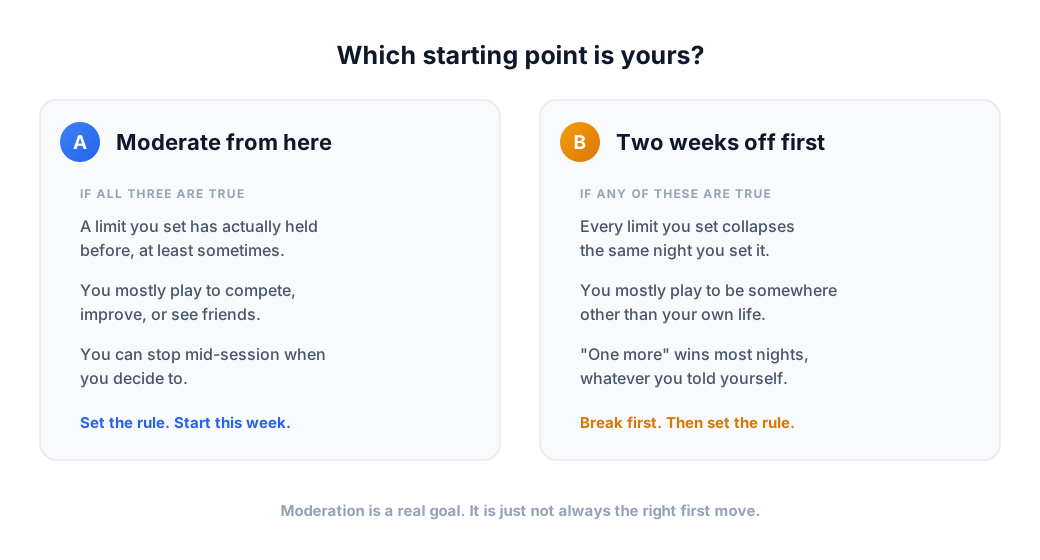
The single best predictor of whether a limit holds is not how many hours you currently play. It is what you are playing for. A survey of thousands of recreational and esports players found one motive standing well clear of the rest when it came to gaming getting out of hand: playing to be somewhere other than where you are. Competition, immersion and skill development were weak signals, or ran in the opposite direction.
If you play mainly to compete or to see your friends, moderation is largely a scheduling problem and tends to work. If you play mainly to be somewhere other than your own life, a limit is a rule about how long you are allowed to keep using your main coping tool, which is why it collapses on precisely the evenings you most needed it to hold. That is not a discipline failure. It is the limit being aimed at the wrong thing.
The other honest marker is control itself. If every limit you have set has died the same night you set it, that pattern is information, and the useful response is a break rather than a stricter version of the rule that keeps failing.
The one technique with real evidence behind it
When you do set a limit, how you phrase it matters more than most people would believe. Peter Gollwitzer and Paschal Sheeran's meta-analysis of 94 independent studies, covering more than 8,000 people, found that turning a goal into a specific if-then plan produced a medium-to-large effect on actually achieving it, with a d of 0.65. Very little in behaviour change research is that well supported.
A goal intention is "I will play less this week." An implementation intention names the situation and the response in advance: if it is a weeknight, then I do not open the game. If I lose a ranked match, then the session is over. If my friends invite me after 10pm, then I say I am out and log off. The mechanism is that you decide once, while calm, so that the moment itself does not require a decision at all.
This is why "I will cut down to about two hours" reliably fails while "no games until Friday, and never after 11" reliably does better. The first needs a judgement call every single night, made by someone tired and already sitting at their desk. The second is a rule you either kept or did not, and you always know which.
Set the limit on when, not how long
Most people cap total hours. Capping the clock works better, and sleep is the reason. When 963 gamers were surveyed about it, the nights they played turned out to be the nights their bedtime quietly slipped: 36 percent of them, by an average of 101 minutes. Two thirds said gaming had cost them sleep.
Three hours on a Saturday afternoon costs you an afternoon. Three hours starting at 11pm costs you the next day as well. A hard stop time protects the thing gaming actually damages, and it has the useful property of being unarguable. You cannot slightly reinterpret whether it is past eleven. If the cut-off is the one rule that keeps collapsing on you, there is more on why in how to stop playing video games at night.
The second rule worth having is one about how sessions end. Deciding in advance that a loss ends the night, rather than justifying one more, removes the exact mechanism that turns a bad game into a five hour evening.
Advice worth ignoring
Three things appear on nearly every moderation list and are worse than useless. The first is using gaming as a reward for finishing your responsibilities. That makes the game the payoff your whole day points at, which strengthens the pull rather than weakening it, and quietly reframes the rest of your life as the tax you pay for it.
The second is breaking gaming into timed intervals with short breaks. It is a study technique, it does nothing about the loop that makes stopping hard, and nobody in the history of ranked has ever paused for five minutes between rounds. The third is "just do your responsibilities first", which is not a strategy, it is a restatement of the problem.
A plan that actually holds
- 01
Take two weeks off before you set any limit. This is the step people skip and it has the best evidence behind it. You are trying to moderate from a calmer baseline, not negotiate with the habit at full strength.
- 02
Write the rule as if-then, not as a number. "If it is a weeknight, then I do not open the game" beats "about two hours a day", because it never requires a judgement call at the moment you are least able to make one.
- 03
Cap the clock, not the hours. A hard stop time protects your sleep and cannot be argued with. Pick it now, not at 10:55pm.
- 04
Decide in advance how sessions end. A loss ends the night. That single rule kills the revenge queue, which is what turns a bad game into a lost evening.
- 05
Add friction to the start, not just the finish. Log out fully, take it off the launch bar, keep it off startup. The cue still fires. Make it land on something that takes five steps.
- 06
Judge it over a month, not a night. One broken rule is not evidence that moderation cannot work for you. Four weeks of the same rule breaking the same way is.
If you are still unsure whether you need to change anything at all, the more useful question is what the hours are displacing rather than the total, which we went through in how many hours of gaming is too much. And if the two week break is the part you cannot get through, that difficulty has a predictable shape, which we set out in what happens when you stop playing video games.
If moderation keeps failing
Some people find that every honest attempt at a limit collapses, over and over, and the useful thing is to stop reading that as a character verdict. It usually means one of two things: the break never happened, so the rule was always fighting a habit at full strength, or the game is doing a job that a rule cannot touch. If what shows up when the game is gone is heavier than boredom, that is worth talking to someone you trust about.
For the ordinary version, deciding once while it is easy is something software is genuinely better at than memory. Gaming Reset builds a weekly routine from your own answers, and its Windows app measures your play and steps in when a game opens, so you see the real pattern rather than the one you assume, and the rule you set on Sunday is still there on Thursday.
You do not have to quit forever to get your evenings back. You do have to stop relying on a version of yourself who is tired, mid-session, and being asked to make a fresh decision every night. Decide once, while it is easy, and let the rule do the arguing.
Frequently asked questions
Can you play video games in moderation?
For most people, yes. Researchers are clear that only a small proportion of people who play games ever lose control of it, and the criteria they use turn on impaired control, priority over other activities, and continuing despite harm rather than on hours played. Moderation tends to work well for people who play mainly to compete, improve, or socialise, and tends to fail for people who play mainly to escape.
Should I quit gaming or just cut back?
The evidence supports a middle path that most advice misses: take a short break first, then moderate. A 2022 study found that a two week gaming break reduced gaming time and daily stress, with effects still holding three months later. Participants returned to gaming, just less of it. If limits you set collapse the same night, a break is the more realistic first step than a stricter limit.
How do I set a gaming limit that actually works?
Phrase it as a specific if-then rule rather than a target number. A meta-analysis of 94 studies covering over 8,000 people found that if-then plans produced a medium-to-large improvement in goal achievement. "If it is a weeknight, then I do not open the game" works better than "about two hours a day", because it does not require a judgement call at the moment you are least able to make one.
Is it better to limit hours or set a cut-off time?
A cut-off time generally works better. It protects sleep, which is what late gaming most reliably damages, and it cannot be reinterpreted in the moment. One survey of 963 gamers found their bedtime slipped on 36 percent of the nights they played, by an average of 101 minutes. A total-hours cap still leaves you deciding when those hours happen.
Why do I keep breaking my own gaming limits?
Usually one of three reasons. The limit was vague, so it needed a fresh decision every night. The habit was never interrupted, so the rule was fighting a cue-driven pattern at full strength. Or the game is meeting a need a rule cannot reach, most often escape. That last one matters most: across surveys of gaming motives, escape is the one that lines up with gaming getting out of hand, and a time limit does nothing about what you were escaping.