How to Quit CS2 When You Have an Inventory and a Decade In
You have quit Counter-Strike before. Then a friend queued, or a case dropped, and the muscle memory did the rest. CS is three habits stacked into one game, and uninstalling only interrupts one of them. Here is what each one is doing, and a plan that deals with all three.
You have quit Counter-Strike before. Maybe after a Premier season that ended worse than it started, maybe after a night that finished at four in the morning on a work day. Then a friend queued, or a case dropped, or you just wanted one before bed, and the muscle memory did the rest.
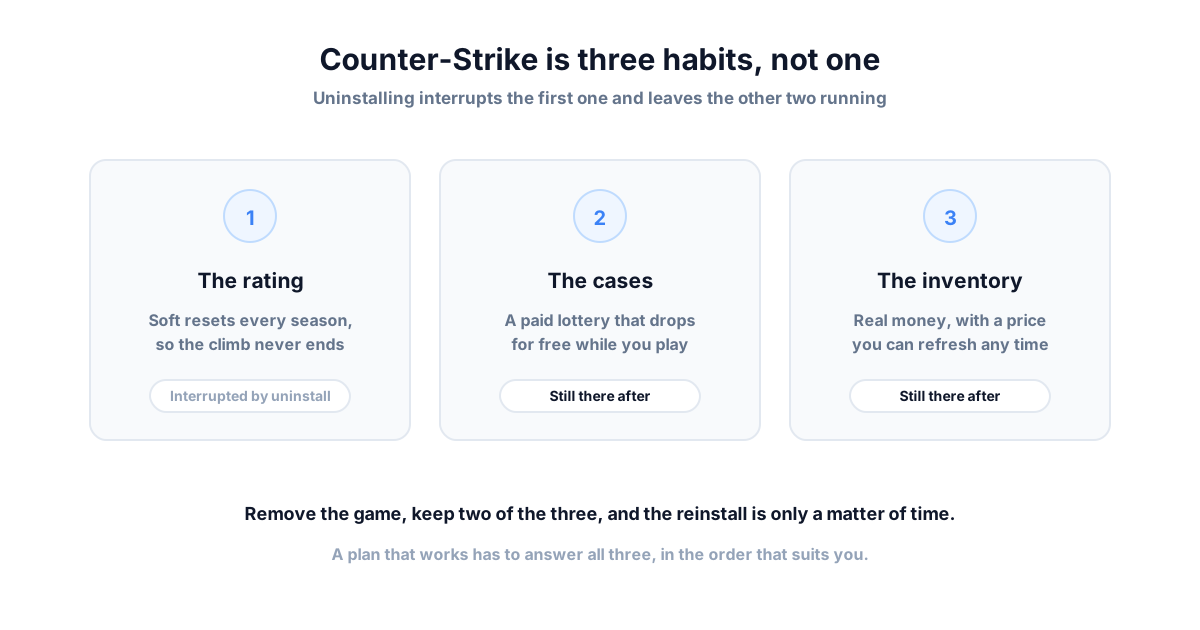
That is not a willpower problem. Counter-Strike is harder to leave than most games for a structural reason: it is three separate habits stacked into one game, and uninstalling only interrupts one of them. This is a guide to stopping properly, which means dealing with all three rather than the one that is easiest to see.
CS2 is not one habit. It is three.
Most quitting advice treats a game as a single thing you either play or do not play. That works for games that are only a game. Counter-Strike stopped being only a game in 2013, when the first weapon case arrived and the whole thing quietly became three overlapping loops.
There is the rating, which resets every season so the climb never finishes. There is the case economy, a small paid lottery running in the background of every match you play. And there is the inventory, which for a lot of players is worth real money and functions as the most literal sunk cost in gaming. Each one hooks differently. Each one needs a different answer. Pull the game off your drive and you have addressed roughly one third of the problem, which is why the reinstall usually arrives within a fortnight.
The rating resets, so you never actually arrive
Premier gives you a single number. Win ten placement matches and you get a CS Rating, which then moves after every game based on whether you won and how strong the opposition was. The best players in the world sit above 30,000. Most people are somewhere in the middle, watching it move.
The number is not the problem. The reset is. Every season does a soft recalibration: last season becomes a starting point and you play ten fresh placements to be sorted again. Whatever you achieved is now a suggestion. If you finished at 15,000 and told yourself you would stop once you got there, the game has already moved the line, and it will keep moving it for as long as the game exists.
This is the same structure that keeps players on the League ladder, and it works for the same reason: a target you can reach is a target you can walk away from, while a target that resets is a subscription to the chase. If you have read how to quit League of Legends, the shape will be familiar. What CS adds is that the rating is only the first of three.
There is a second layer worth knowing about. Valve runs a hidden rating alongside the one you can see, and the gap between the two affects how much you gain or lose per match. So a losing run that feels like it is not tracking your actual play often genuinely is not tracking the number you are watching. You are chasing a figure that sits downstream of a figure you cannot see, which is an efficient way to keep someone queueing to find out.
The cases are a slot machine you already own
A case drops at the end of a match. You did not buy it, you did not ask for it, and it costs money to open. That is the entire design, and it is extremely good at what it does.
The odds are at least published, which is more than most games manage. They were disclosed in 2017 after Chinese regulators required loot box probabilities to be made public. Across standard cases the split is roughly 79.92 percent Mil-Spec, 15.98 percent Restricted, 3.20 percent Classified, 0.64 percent Covert, and 0.26 percent for a knife or gloves. That last figure is about one in 385.
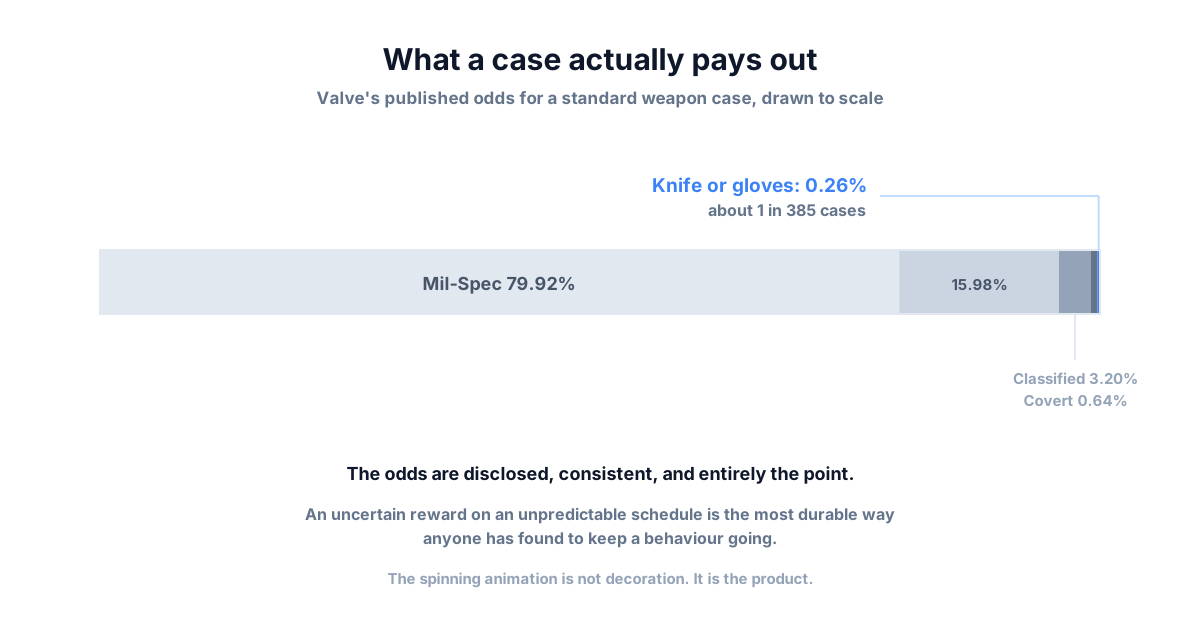
One in 385 is not a scam. It is disclosed, it is consistent across cases, and it is precisely the point. An uncertain reward on an unpredictable schedule is the most durable way anyone has found to keep a behaviour running, which is why the case interface has a spinning animation rather than a results screen. The animation is not decoration. It is the product.
There is research on this specifically. Zendle and Cairns surveyed 7,422 players in 2018 and found that the more someone spent on loot boxes, the more severe their problem gambling score tended to be, with the effect substantially stronger for loot boxes than for ordinary in-game purchases. A replication the following year found non-problem gamblers spent around 11 dollars a month on loot boxes against roughly 38 dollars for problem gamblers. Neither study shows that cases cause anything, and the authors are careful about that. What they establish is that the overlap is real and it is not small.
The inventory is a sunk cost with a price tag on it
Here is where Counter-Strike is genuinely different from Valorant or League. Your Valorant skins are yours and worth nothing to anyone else. Your CS inventory has a market value you can look up, and plenty of players have more money sitting in it than they ever spent on games.
That turns an ordinary psychological trap into a financial one. Sunk cost is the tendency to keep investing in something because of what you have already put in, even when carrying on is the worse choice. It has been studied since at least a 1985 paper in Organizational Behavior and Human Decision Processes, and it does not need money to work. Hours alone are enough. But money makes it louder, and a number you can refresh on a market page makes it louder still.
The thought usually runs: if I stop playing, all of that was a waste. It is worth noticing that this is backwards. The money is spent either way. The skins hold whatever value they hold whether you queue tonight or not. Playing more does not recover anything, it only adds hours to the pile you will feel bad about leaving next time you try.
It is worth seeing the opposite arrangement to understand this one. In EA FC, Ultimate Team deletes your entire club every September and carries forward only the currency you paid for. The asset is destroyed on a known date, and people rebuild it anyway. Which is a useful thing to know while you are staring at an inventory page, because it suggests the attachment was never really about what the items were worth.
Why "just uninstall it" does almost nothing
The uninstall is about ninety seconds of friction. Steam stays on the machine, your friends list still lights up, and the download will finish while you make food. Meanwhile the two habits that actually run you are untouched: the rating is waiting exactly where you left it, and the inventory never went anywhere.
There is also the ordinary habit problem underneath. Research on daily behaviour suggests roughly 43 percent of what people do each day is performed habitually, in a stable context, with very little deliberation. The context here is not the desktop icon. It is the chair, the hour, the friend who messages "queue?", and the specific dead half hour after dinner when you have always opened Steam. Remove the game and leave all of that in place and you have removed a symptom.
How to quit CS2, step by step
- Decide whether you are stopping entirely or cutting back, and pick one before you do anything else. Both are legitimate. What does not work is starting without knowing, because every hard moment then becomes a negotiation you have to win again.
- Close the season deliberately rather than drifting out of it. Either finish the placements you have started or accept out loud that this season is done. An open season is an unfinished task, and unfinished tasks are the thing your brain keeps handing back to you at eleven at night.
- Deal with the inventory before you deal with the game. Not necessarily by selling it. Moving it to a second account, or simply deciding in writing that you are not touching it for ninety days, removes the daily price check. If you do sell, do it once and deliberately, not in pieces on bad evenings.
- Leave the cases unopened. You cannot turn off the drops, but you can decide that unopened is the default. The pull is in the spin, not in the skin, and an unopened case in a stash tab is inert in a way an opened one never is.
- Tell the two or three people who actually queue with you. Not an announcement, just a message. The social pull in CS is specific and personal, and it is much easier to decline a queue invite that already knows the answer.
- Book the hours before you free them. Three or four evenings a week suddenly have a hole in them, and an empty evening at nine is when reinstalls happen. Put something in the slot in advance, even something small.
- Decide now what you will do the first time you want to reinstall, because you will. Write down the actual sentence you will use on yourself, and where you will be sitting when you use it. A decision made in advance is worth ten made at midnight.
If cutting back is what you actually want rather than stopping, the mechanics are different and the evidence points somewhere specific: how to play video games in moderation covers what tends to work and who it tends to fail for.
What the first two weeks actually feel like
The first few days are usually easier than expected and the second week is usually harder. The urge arrives on a schedule rather than continuously, and it is tied to the times you used to play, which is why evenings are the test and mornings are not. What happens when you stop playing video games goes through the timeline in more detail, but the short version is that the discomfort is real, it is not medical, and it fades on a scale of weeks rather than months.
The CS-specific part is the tab. You will open the market page, or check what a skin is going for, and tell yourself it is not the same as playing. It is not the same, but it is the same habit loop with the game removed, and it is the single most common route back in. Treat the market page as part of the thing you are stopping.
When it is about more than the game
Sometimes the game is the problem and removing it is enough. Sometimes it is the place you go when the rest of the day has been too much, and then a plan built around uninstalls and inventory decisions will not hold, because none of it touches the reason. Across surveys of why people play, escape is the motive that lines up most closely with gaming getting out of hand, more so than competition or achievement.
That is worth being honest with yourself about before you start, because it changes what you are actually doing. If the honest answer is that CS is where you go to not think about something else, the game is not really the project. Nothing here is professional advice, and when gaming is tangled up with something heavier, talk to someone you trust. If you want the version of this that applies to any game rather than this one, why competitive games are engineered to keep you hooked is the place to start.
Frequently asked questions
Why is CS2 so hard to quit?
Because it is three habits rather than one. The Premier rating soft resets every season, so the climb never finishes and there is no natural point at which you have arrived. The cases are an uncertain reward on an unpredictable schedule, which is the most durable pattern for keeping a behaviour going. And the inventory holds real money you can look up, which turns ordinary sunk cost into a financial one. Uninstalling interrupts the first and leaves the other two running.
Should I sell my CS2 skins if I want to quit?
Not necessarily, and not in a hurry. The useful thing is removing the daily price check rather than the skins themselves, so moving the inventory to a second account or committing in writing to not touching it for ninety days often does the same job. If you do decide to sell, do it once and deliberately. Selling in pieces on bad evenings tends to keep you on the market page, which is the habit you are trying to leave.
How long does it take to stop wanting to play CS2?
Most people find the first few days easier than expected and the second week harder. Urges arrive tied to the hours you used to play rather than continuously, so evenings are the difficult part and mornings usually are not. The discomfort tends to fade on a scale of weeks rather than months. It is uncomfortable, not dangerous, and it is not a withdrawal syndrome in any clinical sense.
Can I just play CS2 casually instead of quitting?
For plenty of people, yes. Moderation tends to work for players whose pull is competition or socialising, and tends to fail for players whose pull is escape. The practical catch in CS is that casual play still drops cases and Premier still resets, so the two loops that are not the game itself carry on regardless. If you want to moderate, it usually helps to take a short break first and set a rule about when you play rather than how long.
Why do I keep reinstalling CS2 after I quit?
Because uninstalling removes about ninety seconds of friction and nothing else. Steam is still installed, the friends list still lights up, and roughly 43 percent of daily behaviour runs habitually off context rather than decisions. The cue is not the desktop icon, it is the chair, the hour and the message asking if you are queueing. Unless those change, the reinstall is only a matter of when.
Is opening CS2 cases gambling?
Legally it depends on the jurisdiction and the answer keeps changing. What the research shows is that the overlap is real: a 2018 survey of 7,422 players found that heavier loot box spending tracked with more severe problem gambling scores, and a replication the next year found non-problem gamblers spent about 11 dollars a month against roughly 38 for problem gamblers. That is a correlation rather than proof of cause, but it is a consistent one, and the mechanic is designed around uncertainty in the same way.
Ready to break the loop?
A simple daily plan built around how these hooks actually work, tracked in one app on web and mobile. Start free for 3 days.
Start free, 3 days →