How to Quit League of Legends (When the Climb Will Not Let Go)
You have quit League before. You hit the rank, told yourself one more season, and were back in ranked by the weekend. That is not weakness. The ladder is built so you never quite arrive. Here is why, and how to actually stop.
You have quit League before. You hit the rank you were chasing, or you lost the promo and rage-uninstalled, and either way you told yourself that was it. Then a patch dropped, or a friend asked for a duo, or the new season started with a clean slate, and you were back in ranked by the weekend. If that loop is familiar, here is the first thing to understand: you are not weak, and the problem is not really the game. It is the ladder.
This is a practical guide, not a lecture. First we will look at why League specifically is so hard to leave, because you cannot beat a system you cannot see clearly. Then we will get into an actual plan to stop, and what the first couple of weeks really feel like.
You are also not alone in this by a wide margin. Third-party trackers estimate that well over a hundred million people play League every month, and for a competitive slice of them it long ago stopped being about fun and became about the number next to their name.
You are not hooked on League. You are hooked on the climb
A single-player game ends. You beat it, credits roll, and the thing is complete. Ranked has no such thing as complete, and that is not an accident. Every rank has a rank above it. Every season wipes the ladder and asks you to prove it again. The one structure guaranteed to keep you playing is a goal you can never finish reaching, and that is exactly what a competitive ladder is.
Underneath the rank you see is a hidden number. Riot is explicit that your matchmaking rating is a secret, and your visible rank is just a translation of it: win and it goes up, lose and it goes down. The point of that design is that there is always another number to chase, and the chase is the product.
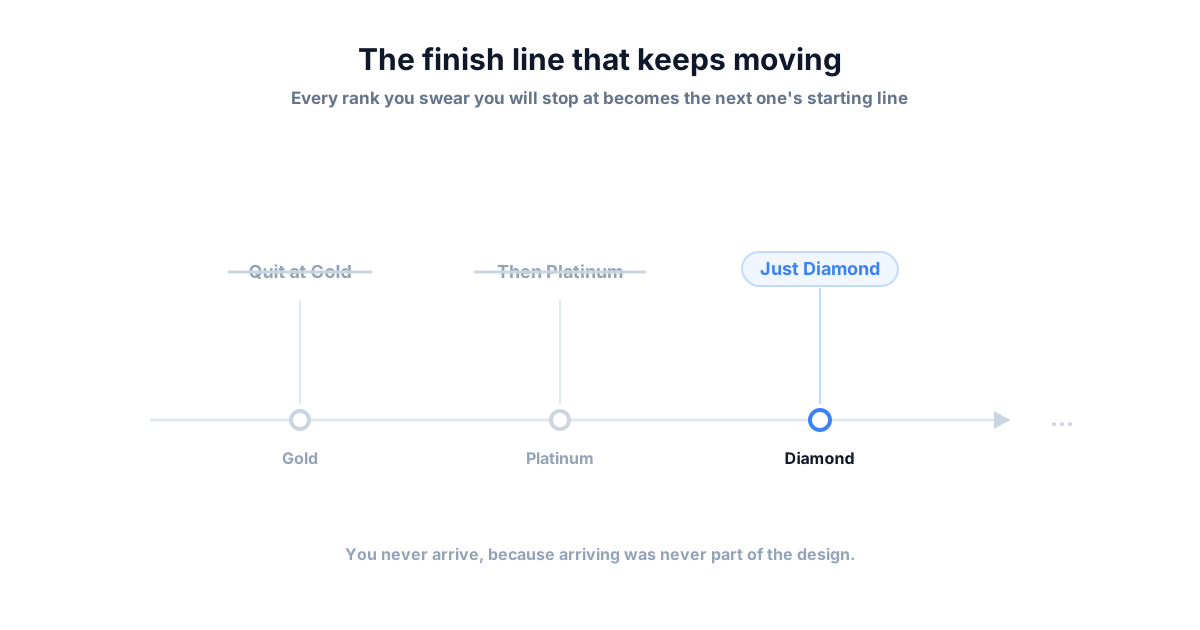
This is why "I will quit when I hit Gold" never works. You hit Gold and Gold immediately feels like the floor, not the finish, because the ladder has already shown you Platinum. The finish line was never fixed. It moves up to meet you every time you reach it, and a target that moves is a target you can chase forever.
A rank is not a finish line. It is the next starting line, dressed up to look like an ending.
The elo hell trap, and why it keeps you queuing
Somewhere in a bad session you have probably decided the system is against you. Your teammates are the problem, the matchmaking is rigged, you are stuck in elo hell or forced into a losers queue after a win streak. It feels true, especially at 1am after a fourth loss. It is worth knowing that Riot has addressed this directly, because the belief is doing more damage than any of your teammates.
In an official developer post on matchmaking, Riot states that most teams have an expected win rate of 50 give or take 1 percent, calls the idea of a punishing losers queue "pretty much an urban myth", and says plainly that there is nothing in the system forcing you to have lower-skill teammates or stronger opponents. The game is trying, imperfectly, to hand you a coin-flip every time you queue.
Here is why that matters for quitting rather than for climbing. The elo hell story is not just wrong, it is the engine of the trap. You decide the game is rigged, so you tilt and blame the team and maybe flame in chat, so you play worse and chase the loss instead of stopping, so you drop LP, which feels like proof the game was rigged all along. The belief manufactures the evidence for itself, and every lap around that loop is another hour you did not mean to spend.
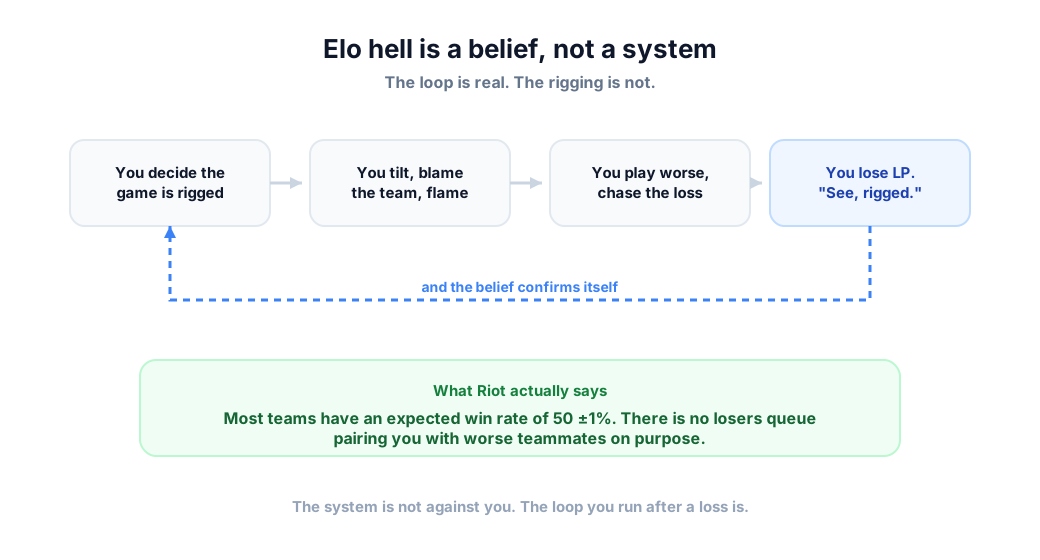
None of this means every game is winnable or that you never get a genuinely rough team. It means the pattern you are stuck in is a pattern you are running, not a cage the game built around you, and that is oddly good news, because a loop you run is a loop you can step out of.
The revenge queue arrives exactly when you should log off
Losing LP stings more than gaining the same LP feels good, so a loss leaves a debt, and the fastest-looking way to repay it is to queue again right now. That is the revenge queue, and it shows up at precisely the moment you should be closing the client. One more game to end on a win is how a bad night becomes a five-hour one.
There is a nastier version of this once you have climbed slightly past where your hidden rating says you belong. Because LP gains and losses track that hidden number, every defeat then costs a little more than a win pays, and no amount of grinding fixes it, because the gap is the whole point. It is the same ranked machine we pulled apart for another Riot game in the guide to quitting Valorant, and the same four hooks that make any competitive game hard to leave, which we broke down in why competitive games are engineered to keep you hooked.
Why "just uninstall it" never sticks
Uninstalling deletes the client, not the account. Your rank, your champion mastery, your skins, and your friends list are all still sitting on Riot's servers, and the client is a fifteen-minute download away. So the game is never actually gone, which is why deleting it in a tilt at 2am almost never survives past the weekend. You did not quit. You added a loading screen, and the season is still running without you.
Trying to just play less usually fails too, at least early on. For most people deep in the ranked grind, one game becomes five, because the loop is built to pull you back. Moderation is a perfectly reasonable end goal, and the evidence actually favours taking a clean break first and moderating from there, which we go through in how to play video games in moderation. In the beginning, a firm break is far easier to hold than a fuzzy limit you renegotiate after every loss.
How to quit League, step by step
This is a plan built around how the ladder actually works, instead of relying on willpower you have already spent by the end of a ranked session.
- Set your own finish line, because the ladder will not. Pick a date you stop, not a rank you stop at. A rank is a target that moves the moment you reach it; a date on the calendar does not. "I am done on the 30th" beats "I am done at Diamond" every time.
- Make a loss end the session, and decide it now. Write the rule in advance, while you are calm: if I lose a ranked game, the night is over. Pre-deciding the exact response to the exact situation is the single best-evidenced tool for making a limit hold, so use it here.
- Drop the elo hell story on purpose. Whether you are quitting or just cutting back, telling yourself the game is rigged is what fuels the tilt and the revenge queue. Retiring that belief removes the "let me just climb out of this bad patch first" excuse that keeps the account open.
- Add real friction to starting. Uninstall the client, log out of your Riot account, and take it off your startup apps. Then add a blocker like Cold Turkey or Freedom, so reinstalling at your lowest moment is a five-step decision instead of one click.
- Tell your duo and your premades. If your friends are the reason you queue, say what you are doing and ask them not to invite you for a while. Real friends understand. If a friendship only exists inside the client, that is painful but useful to learn.
- Rebuild who you are without the rank. If your rank had quietly become a measure of you, decide who you are becoming before you stop, so quitting reads as a step toward something rather than only the loss of a number.
- Plan the hardest day before it arrives. The urge spikes early and hits at a predictable time of night. Decide now what you will do when it comes, while you are thinking clearly, instead of trying to out-argue yourself mid-tilt.
What the first two weeks feel like
Stopping a game you played every day is a real adjustment, and it is mostly a boring one rather than a dramatic one: a stretch of restlessness, irritability, and evenings that feel oddly long. The urge tends to arrive fast and then fade sooner than it feels like it will on the worst day. We laid out what the research does and does not actually establish about that timeline in what happens when you stop playing video games, including why the confident day-by-day detox timelines you will find elsewhere are not as solid as they look.
The reinstall almost never happens during an intense craving. It happens on a flat Tuesday with nothing else planned, when the client is one download away and the evening is empty. That is the moment to prepare for, and it is beaten with a plan for the evening, not with more resolve.
When it is about more than the climb
One honest branch. If League is mostly the place you go to be somewhere other than your own life, quitting the game is only part of the work. When thousands of players were asked why they played, the motive that lined up most strongly with gaming getting out of hand was escape, not competition or improvement. If that is you, the ranked ladder is doing a job, and pulling it away without addressing the job is why attempts fail and keep failing.
That is not a reason to skip the break. It is a reason to be honest that the break buys you room to deal with what you were escaping, rather than dealing with it for you, and that naming it to someone you trust does more than any amount of willpower aimed at the client.
For the day-to-day of it, structure carries the weight that willpower gets blamed for. That is what Gaming Reset is built to do: it turns your own answers about your habit into one small step a day and keeps your progress visible, so staying out of the queue does not depend on the resolve of someone who just lost a promo at midnight. The ladder is very good at asking you for one more game. This is a system that answers for you.
You do not have to hate League to admit it was built to keep you climbing. It is a brilliant piece of design, and that is exactly the problem, because brilliant design is hard to walk away from. Seeing the ladder clearly is the first honest step. The second is deciding, on purpose, where your finish line is, because the game is never going to draw one for you.
Frequently asked questions
Why is League of Legends so hard to quit?
Mostly because the ranked ladder is designed never to finish. Every rank has one above it, every season resets your progress, and a hidden matchmaking rating means there is always another number to chase. On top of that, the belief that the game is rigged against you fuels tilt and revenge queuing, which keeps you playing far longer than you intended. It is less about being hooked on League itself and more about being attached to a climb that has no end built into it.
Is elo hell real?
Not in the way most players mean. In an official post on matchmaking, Riot says most teams have an expected win rate of about 50 percent, calls the punishing "losers queue" pretty much an urban myth, and states there is nothing forcing you to get weaker teammates. Individual games can genuinely be rough, but there is no system trapping you at a rank. The real effect of believing in elo hell is that it makes you tilt and play worse, which lowers your rank on its own.
How long does it take to quit League of Legends?
The hard part is front-loaded. The urge to play tends to show up within the first day or two and then eases over the following weeks, and the most common effects are simply irritability and restlessness rather than anything dramatic. Be sceptical of confident day-by-day timelines, since the research on how these effects fade is genuinely underdeveloped. What people consistently report is that the daily pull drops off noticeably within the first couple of weeks.
Can I just play League less instead of quitting?
Eventually, often yes. Early on, moderation usually fails, because the ranked loop is built to turn one game into five, especially after a loss. A clean break for a set period is far easier to hold than a vague limit, and the evidence suggests a short break is actually the most reliable route to moderating later from a stronger position.
Why do I keep reinstalling League after I quit?
Because uninstalling removes the client, not the account, the rank, the friends, or the habit, and the client is a short download away. Reinstalls also tend to happen on empty evenings rather than during intense cravings. Add real friction, such as logging out of your Riot account, removing it from startup, and using a blocker, and decide in advance what your evenings are for, so your lowest moment is not one click from a queue.
What should I do instead of playing ranked?
Replace what the climb was giving you, not just the hours it filled. If it was the feeling of measurable progress, pick something else with a visible curve, such as training or a skill you can track. If it was your friends, find a shared activity off the client. Setting a fixed stop date and a rule that a loss ends the session also removes the two mechanics, the moving finish line and the revenge queue, that do most of the work of keeping you in the queue.
Ready to break the loop?
A simple daily plan built around how these hooks actually work, tracked in one app on web and mobile. Start free for 3 days.
Start free, 3 days →