How to Stop Playing Video Games at Night (It Is Not the Blue Light)
It is 12:40, you have work in seven hours, you are not even enjoying this one, and you queue again. Blue light did not do that. Here is the mechanism the sleep advice misses, and the two rules that actually hold.
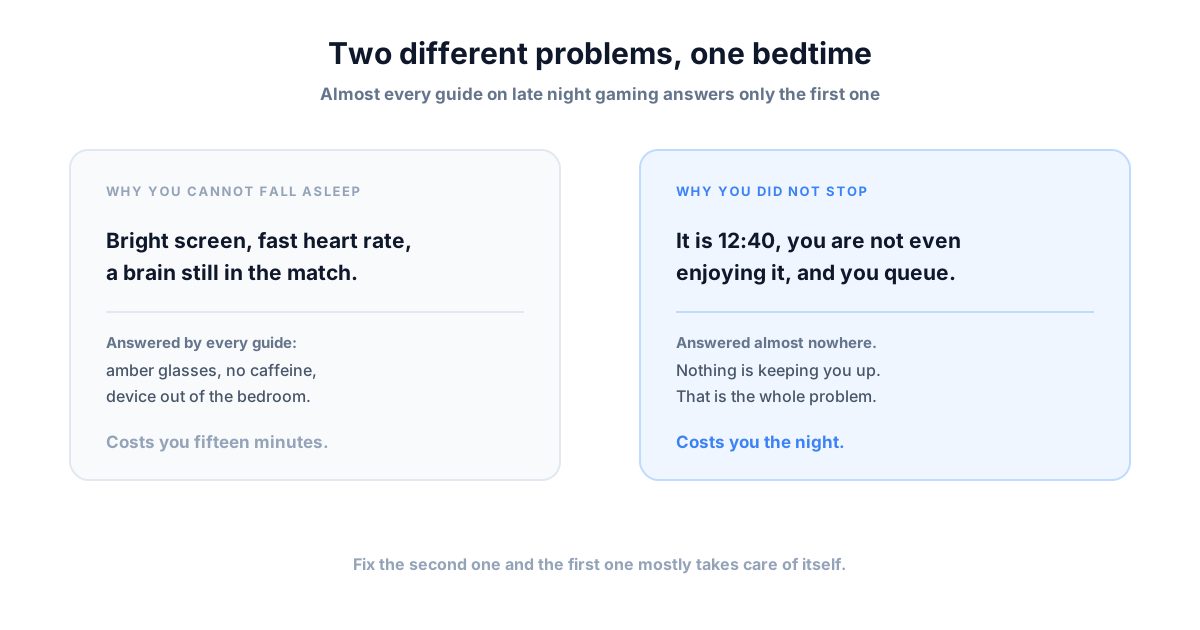
It is 12:40 on a Tuesday. You have work in seven hours. You are not even enjoying this particular game, and you queue again anyway. Nothing is stopping you. That last sentence is not a figure of speech, it is the most important detail in this entire article, and it is the one every guide on late night gaming manages to skip.
The advice you have already found tells you to wear amber glasses, cut caffeine after four, keep the console out of the bedroom, and take a warm shower. None of it is exactly wrong. It is simply aimed at a different problem from the one you actually have.
Every guide answers the wrong question
There are two separate problems on a late gaming night, and almost nobody pulls them apart. The first is why you cannot fall asleep once you finally do stop. That one is real enough. You are wired, your heart rate is still somewhere in the last fight, and a bright screen has been sitting an arm's length from your face for four hours.
The second problem is why you did not stop at eleven. Nothing in the standard advice touches that, and it is the one that costs you the night. If you had logged off at eleven, a slightly slow wind-down would have cost you fifteen minutes. Instead you logged off at one, so it cost you two hours and the fifteen minutes.
It is also worth knowing how thin the most recommended fix on that list actually is. A 2023 systematic review of blue-light filtering lenses concluded that they probably make no meaningful difference to sleep quality. It is the item that appears in almost every article written on this subject, and the evidence behind it is close to nothing.
What is actually happening at 12:40
Psychologists have a name for what you are doing, and the definition is unusually blunt. In 2014, Floor Kroese and colleagues introduced bedtime procrastination and defined it as failing to go to bed at the intended time, while no external circumstances prevent a person from doing so.
Read the second half of that again. No external circumstances prevent a person from doing so. Nobody is keeping you up. There is no deadline, no emergency, no crying baby. The entire phenomenon is defined by the absence of a reason, which is exactly what makes it impossible to argue yourself out of in the moment. There is nothing there to argue with.
In their sample of 177 adults, bedtime procrastination tracked strongly with low self-regulation and predicted short sleep on its own. Thirty percent were getting six hours or less on a weeknight, and 84 percent said they felt tired or short of sleep at least once a week.
Notice what is missing from that description: games. Bedtime procrastination is an ordinary human problem that games happen to be exceptionally good at exploiting. That is mildly reassuring and slightly worse news than you were hoping for, because it means uninstalling the game does not automatically fix the hour.
Nothing is keeping you up. That is not a detail around the edge of the problem. That is the definition of it.
Why it is always the evening and never the morning
Here is the part that makes it click. You have never once woken at six and thought, I will steal an extra hour for myself before work. The reclaiming only ever happens at night. Whatever this is, it is not a general shortage of self-control, because the same person exercises plenty of it at 8am.
A 2018 study offers the first half of the answer. Researchers asked 218 people how many desires they had resisted across the day and how badly they delayed going to bed that night, and found that the more people had resisted during the day, the later they went to bed. The correlation was modest rather than dramatic, so hold it loosely, but it points exactly where you would expect.
Their own conclusion is worth repeating, because it is the opposite of what you have probably been telling yourself. Simply buckling down and exerting more self-control, they wrote, is unlikely to succeed. Not because you are weak, but because at midnight you are being asked to pay with a currency you already spent at work.
The second half is about what the hour is worth to you. When we looked at what games are actually giving you, one of the three needs was autonomy: the sense that this time is genuinely yours, with nobody needing anything from you. For a lot of adults, the only stretch of the day that clears that bar is the one after everybody else has gone to bed.
Which changes what going to sleep actually feels like. You are not choosing between a game and rest. You are being asked to hand back the only part of the day that belonged to you, and go unconscious, so you can start the next one. Put that way, one more game is not irrational at all. It is the most understandable thing in the world, and it will still cost you Wednesday.
What games add to an ordinary bedtime problem
Everything you might do late at night has some version of this pull. Gaming has three features that make it considerably worse.
The first is that a session has no natural end. A film has credits. An episode runs out. A book has a chapter break that gives you a clean place to stop. A match ends and puts a queue button exactly where the ending should be. Nothing in the activity ever tells you it is over, so the stopping has to be generated entirely by you, every single time, at the hour you are least equipped to generate it.
The second is that losing is the hook rather than the deterrent. The urge to play again is loudest immediately after a bad game, which is also the version of you least interested in going to bed. We went through that mechanism in detail in the guide to quitting Valorant, and it is at its most effective after eleven.
The third is that other people are still online, so logging off stops being a decision about sleep and becomes a decision about leaving. That one is hardest to argue with, because it is not really about the game at all.
Together they produce a very specific and very measurable pattern. In a 2016 survey of 963 gamers, bedtime moved on 36 percent of the nights they played, and when it moved, it moved by an average of 101 minutes. Not occasionally. On more than a third of the nights they played. More than two thirds said gaming had cost them sleep.
Two rules, not ten
You do not need a bedtime routine. You need two decisions, made once, in daylight, by the version of you who is not currently mid-session.
- Set a last-queue time, not an hours budget. Not "about two hours a night". Last queue at eleven. One of those requires a judgement call at midnight and the other does not.
- Decide in advance how the session ends. A loss ends the night, or the queue that would finish after your cut-off does not get started. Pick one and make it mechanical, so the end of the evening is not something you have to talk yourself into.
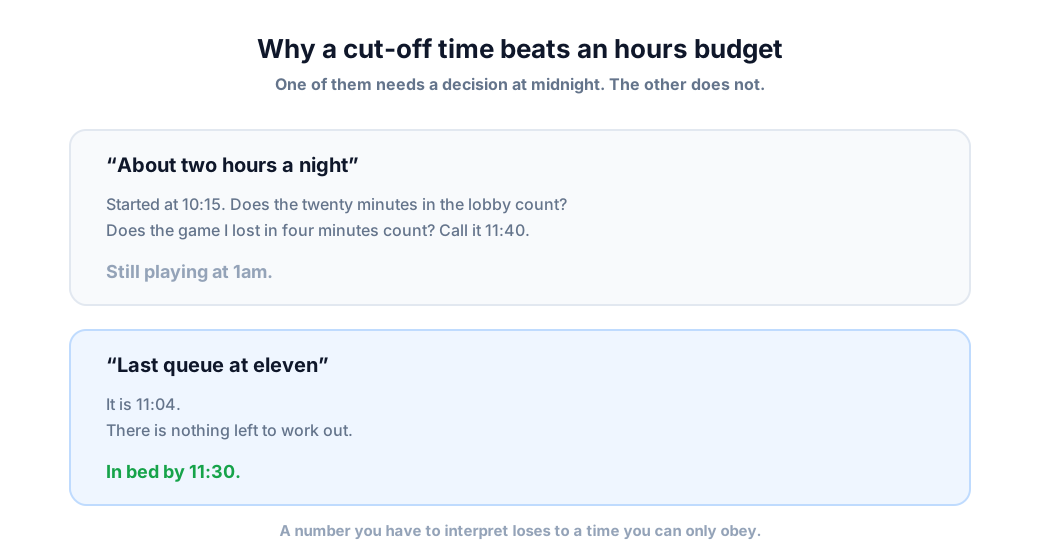
The reason to prefer a clock time is that it cannot be reinterpreted. An hours budget is a running negotiation, and by midnight you can always locate fifteen minutes that were not really playing. Eleven o'clock is eleven o'clock. We made the same case in how to play video games in moderation, and it holds harder at night, because the thing an hours cap fails to protect is precisely the thing that late sessions take.
Phrase both rules as if-then, because that phrasing has better evidence behind it than almost anything else in behaviour change. Peter Gollwitzer and Paschal Sheeran's meta-analysis of 94 studies, covering more than 8,000 people, found that turning an intention into a specific if-then plan produced a medium-to-large effect, with a d of 0.65.
That is also, not coincidentally, what the bedtime procrastination researchers landed on. Having concluded that more willpower will not work for someone who is already depleted, they pointed at pre-planned responses to specific cues instead. The people studying why you are still awake and the people studying how to make a rule stick arrived at the same tool from opposite directions.
The part the sleep advice always misses
There is one more move, and skipping it is why the rules quietly collapse in week two. If the reason you stay up is that the night is the only time that belongs to you, then a rule that simply deletes the night is not a solution. It is a pay cut, and you will find a way to take the money back.
So do not only end the evening earlier. Move something you actually chose into the hour you just freed up. It does not have to be productive and it is allowed to be completely pointless. It only has to be yours, and it has to not be the game. The need was never for gaming specifically. It was for one part of the day nobody else had a claim on.
That is the structural reason the standard list fails. It is made entirely of removals. Take the device out. Cut the caffeine. No screens for an hour before bed. Every item is something taken away from you, written for someone whose problem is that they have too much. Your problem is that you have too little, and midnight is the only place left to take it from.
What the first week is like
Expect the first three or four nights to be the hardest, and expect the pull to arrive at almost exactly the same time each night, because it is a cue firing on schedule rather than a fresh decision. That front-loading is the same shape a full break takes, which we set out in what happens when you stop playing video games. Knowing the spike is coming, and that it is early, is most of the difference between holding the rule and renegotiating it.
One honest caveat. If the late nights are less about the game and more about not wanting the day to end, or about what gets loud in the quiet once the screen is off, a cut-off time is not going to reach that. It is still worth setting, but it is worth saying out loud to someone you trust rather than solving alone at 1am.
The two rules are easy to write down and hard to still be following on a Thursday. Closing that gap is what Gaming Reset does. Your answers about your own evenings turn into one specific step a day with the record kept for you, so the rule you set in daylight is still doing its job at the hour you would most like to renegotiate it.
You are not staying up because you lack discipline. You are staying up because the night is the only part of the day that asks nothing of you, and a game is very good at holding onto anyone who wants that. The fix is not to want it less. It is to take that hour somewhere that does not charge you the next day for it.
Frequently asked questions
How do I stop playing video games at night?
Set a last-queue time rather than an hours budget, and decide in advance how the session ends, for example that a loss ends the night. A fixed clock time works better because it cannot be reinterpreted at midnight, while an hours cap needs a judgement call at the moment you are least able to make one. Then put something you actually chose into the hour you free up, because the late hour was serving a purpose and removing it without a replacement rarely holds.
Why do I keep gaming until 2am even when I am tired?
Because it is bedtime procrastination, defined in the research as failing to go to bed at the intended time when nothing external is preventing you. One study found that the more desires people resisted during the day, the later they went to bed, and the authors concluded that exerting more self-control is unlikely to work for someone already depleted. For most adults the late hours are also the only part of the day nobody else has a claim on, so going to bed feels like giving that up.
Do blue light glasses help gamers sleep?
Probably not much. A 2023 systematic review of blue-light filtering lenses concluded they likely make no meaningful difference to sleep quality. They are the most commonly recommended fix in articles on late night gaming and among the least supported. They also address the wrong problem, since they target how quickly you fall asleep after you stop rather than why you did not stop two hours earlier.
Is it better to limit gaming hours or set a cut-off time?
A cut-off time. An hours budget is a running negotiation, and late in the evening you can always find time that did not really count. A clock time cannot be reinterpreted, and it protects sleep specifically, which is what late sessions actually take. In one survey of 963 gamers, bedtime moved on 36 percent of the nights they played, by an average of 101 minutes.
Why is it so hard to stop after just one more game?
Partly because a session has no natural end. A film has credits and a book has a chapter break, but a match finishes and puts a queue button where the ending should be, so stopping has to come entirely from you every time. The urge is also loudest right after a loss, which tends to be the version of you least interested in going to bed.
Does late night gaming actually matter, or is it just lost sleep?
The lost sleep is the main cost, and it is larger than most people assume. Survey data puts the average delay at 101 minutes on the nights it happens, which is not a rounding error across a working week. The more useful question is not whether one night matters but whether the pattern is taking tomorrow as well, since the hours come directly out of the following day rather than out of your free time.
Ready to break the loop?
A simple daily plan built around how these hooks actually work, tracked in one app on web and mobile. Start free for 3 days.
Start free, 3 days →