Habits · 11 min read
How to Stop Playing Video Games: Two Weeks First, Then for Good
Uninstalling never lasts, and cutting down keeps drifting back to the old hours. Here is what the research says works better, and a plan for the first two weeks, which is where the hard part sits.
Contents10 sections
You have probably stopped before. You deleted the game, uninstalled the launcher, maybe told someone you were done for a month. It lasted a week, perhaps two, and then one quiet evening it was back, and that felt like proof that you cannot do it. It is not proof of anything except a plan with gaps in it. If you are working out how to stop playing video games, the usual attempt breaks in a few predictable places, and almost none of them comes down to willpower.
This guide covers the whole thing in order: whether to stop completely or cut down, what to set up before day one, how to get through the first two weeks, what to do if you slip, and how to decide what comes after. If one game is behind most of your hours, the game-by-game guides are near the end.
Should you quit gaming, or just cut back?
Not everyone who plays a lot needs to stop. The hours matter less than what they are pushing out of your life, which is the case we make in how many hours of gaming is too much. Plenty of people play for hours, sleep fine, turn up for the people around them and have nothing to fix.
But if you are reading this, cutting back has probably been tried already. Three questions settle most cases:
- 01
Have your limits collapsed the same night you set them? A limit that keeps failing on day one is not really a limit problem. The habit is running at full strength, and no rule holds against that until it has had a break.
- 02
Do you mainly play to get away from something? Playing to compete, improve or see friends is different from playing so you do not have to sit with your own evening, and the second kind does not respond to time limits.
- 03
Is one game behind most of the hours? Then that game's own hooks are part of the problem, and the guides near the end of this page go through them one game at a time.
A yes to any of them points the same way: stop completely for a set period, then decide. If none of them fits, you may be able to play video games in moderation from the start, and that guide is the better place to begin. Either way, nobody has to decide about forever today. That decision goes much better with two weeks of real information behind it.
Why stopping outright beats cutting down
The most common advice online is to cut down slowly, and some of the best-known guides call cold turkey the least effective option. The best evidence on that exact question points the other way.
The cleanest test comes from smoking. In a randomised trial with 697 adult smokers, people were assigned either to stop on a set day or to cut down by three quarters over the two weeks before it, with the same support otherwise. Four weeks after quit day, 49 percent of those who stopped outright were still not smoking, against 39 percent of those who cut down first. At six months it was 22 percent against 15.5. The authors concluded that stopping outright worked better even for the smokers who would have preferred to cut down.
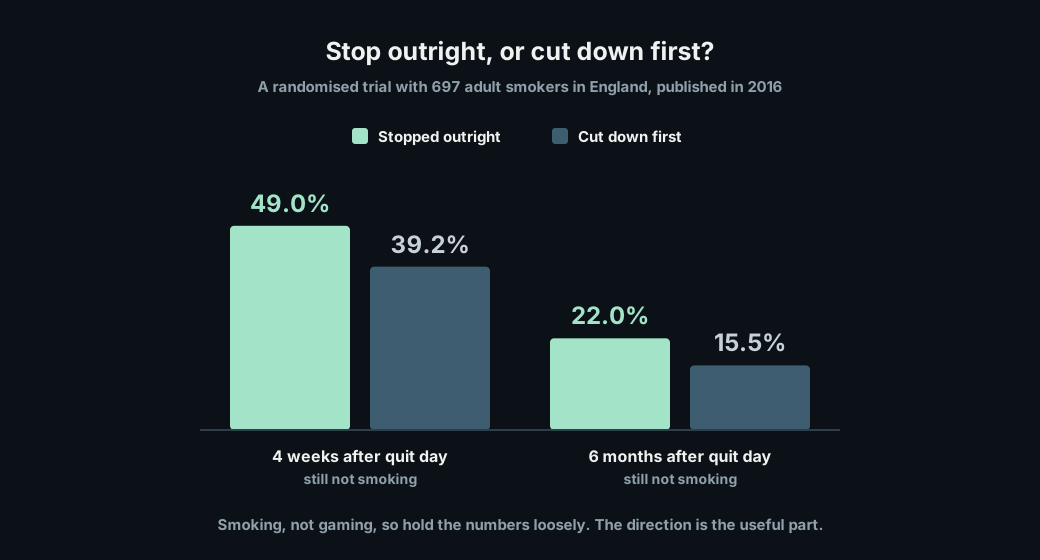
That is nicotine, not games, so hold the numbers loosely. But the reason behind them carries over. Cutting down turns every evening into a negotiation about how much is fine tonight, and the person doing the negotiating is the one least interested in a strict answer.
Cutting down is a decision you have to win every evening. Stopping is a decision you make once.
The research on games points the same way. In a German experiment with 271 adult players, 131 stopped gaming completely for two weeks while 140 carried on as normal. The break cut their gaming time and their day-to-day stress, they came out of it feeling better overall, and the difference was still there three months later. Two weeks did more than pause the habit. It changed where the habit settled afterwards.
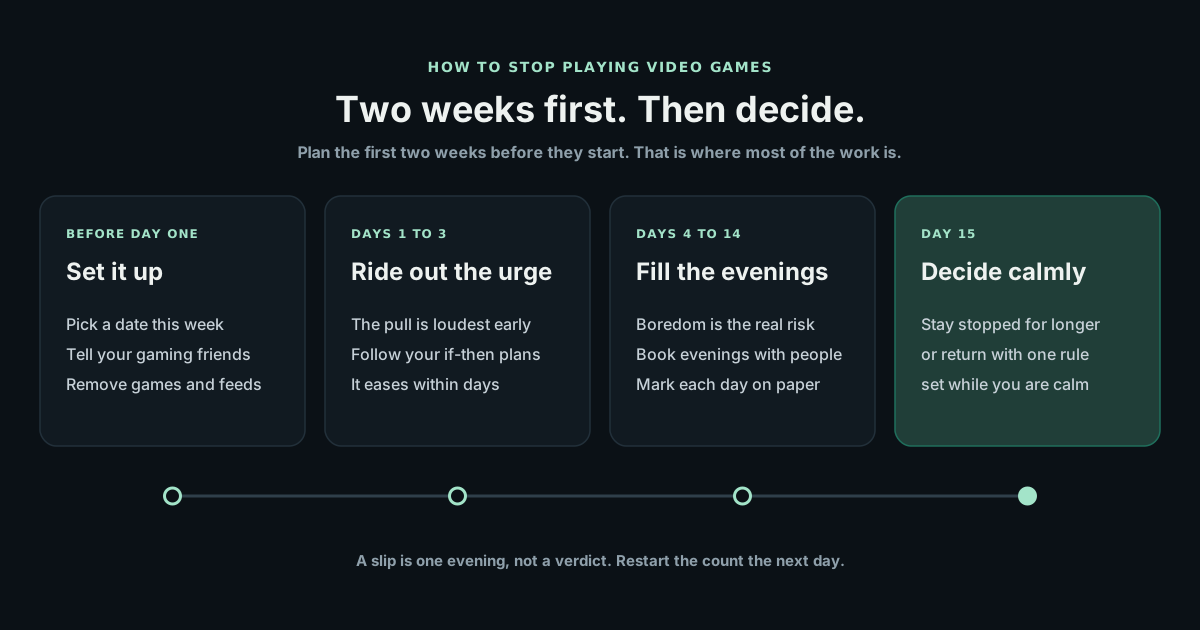
Before day one: pick a date and clear the cues
Most of the work happens before you stop, and it starts with when. People are measurably more likely to start on a goal just after a clean line in the calendar. A study of the fresh start effect found that searches for the word diet, gym visits and new goal commitments all rose after the start of a new week, month or year, and after birthdays and holidays, as if each new period put the old failures in a previous chapter. So pick a Monday or the first of the month, inside the next seven days, rather than someday.
Then deal with the cues, because a habit lives in its surroundings more than in your head. When researchers followed students moving to a new university, their exercise, newspaper and TV habits survived the move only when part of the old setting came along, such as reading the paper with the same people. Gaming has the same anatomy: the chair, the desk, the hour after dinner, the friend who comes online at nine. Remove what you can, and change what you cannot.
- 01
Pick the date and the length. Two weeks at least, written down, starting inside the next seven days. A fixed end gives you something to finish rather than something to endure.
- 02
Tell the people you play with before the date. A short message is enough: you are taking two weeks off from Monday. It removes the invitation you would otherwise have to turn down live, and it turns a private plan into a public one.
- 03
Uninstall the games, then the launchers. Remove Steam, the Epic Games Launcher, the Riot Client, Battle.net and anything else you play through, so that playing anything means reinstalling it first.
- 04
Leave the servers and the feeds. Mute or leave the game's Discord servers, unfollow the streamers and stop the gameplay videos. Watching other people play keeps the game in your evenings even when it is not installed.
- 05
Change the room. Move the chair, turn the desk, or spend the first evenings somewhere else entirely. The setting is half of the habit.
- 06
Decide what the first three evenings are for. Not a vague better use of the time, but a specific thing at a specific hour for each one.
Before step three, write down what your launchers say about your last two weeks. How to check hours played on PC shows where each one keeps its count. It gives you a number to compare the break against, and it is usually bigger than you expected.
If you play anything from Riot, its anti-cheat is a separate program. Riot's own guide to removing Vanguard says to find Riot Vanguard in Add or Remove Programs, uninstall it and restart, and that it is gone once its icon no longer appears in the tray. For the evenings themselves, what to do instead of gaming has a way of choosing that starts from what the game was actually doing for you.
Days one to three: the urge is loudest early
The first days are the sharpest, and they are also the shortest. In a study that followed 24 regular online players through an 84-hour break, the urge to play, low mood and stress all eased as the break went on rather than building up, and for the players whose gaming was most problematic, the biggest drop came within the first 24 hours. A review of 34 studies on what stopping feels like found the effects described most consistently were irritability and restlessness, while warning how little research there is on the question.
So expect the first evenings to feel wrong in a dull, twitchy way, and expect the pull to arrive on schedule: at the time you would normally sit down, after a bad day, or when a friend comes online. Because it is predictable, you can answer it in advance.
The tool for that is an if-then plan, a rule that names the moment and what you will do instead. Across a meta-analysis of 94 studies of plans like these, spelling out when, where and how you would act had a medium-to-large effect on whether people followed through. A few that fit gaming:
- If I sit down at the desk after dinner, I put my shoes on and walk for ten minutes first.
- If someone invites me to play, I say I am off until the date I gave them, and put the phone in another room.
- If I catch myself opening a gameplay video, I close it and message a friend instead.
- If it has been a bad day, I let it be a bad day rather than fixing it with a game.
What happens when you stop playing video games goes through the first weeks in more detail, including why the dopamine detox story you may have read gets the mechanism wrong.
Days four to fourteen: the evenings are the real problem
Once the sharp edge goes, a quieter problem replaces it. Gaming was not only filling your evenings, it was shaping them. It decided when the night started, what you were doing and when it ended. Without it you get several hours of unshaped time every day, and this is where attempts tend to end: on an ordinary evening with nothing planned, not a dramatic one.
So plan the evenings, not just the absence. Put something with other people into at least two of them each week, because a fixed time with someone expecting you is the hardest kind of plan to cancel. Give the rest a default, even a small one, so the question at seven o'clock is never what now.
Then keep a record. In a meta-analysis of 138 studies with nearly 20,000 people, monitoring progress helped people reach their goals, and it helped more when the progress was physically recorded or reported to someone else. Here, that means a mark on a paper calendar for every day you stay off, and one person who hears how it is going each week.
If you slip, it is one evening, not a verdict
Plenty of people who stop have an evening where they play anyway. What decides how it ends is not the slip itself but the story you tell yourself about it the next morning.
Researchers who study people giving up smoking, drinking and similar habits have looked closely at that story. A review of their research on giving up habits describes it plainly: treating a slip as a personal failure can lead to guilt and to dropping the goal altogether, and that is more likely when you see stopping as all or nothing, or overlook what about the situation set it up.
So when it happens, do three things the next day. Name what set it up, as plainly as you would describe someone else's evening: tired, alone, a friend online at nine. Write an if-then plan for exactly that moment. And restart the count straight away rather than on Monday, because a fresh start is useful for beginning and costly when it becomes a reason to wait.
The one thing not to do is reinstall to check whether you still enjoy it. That is the easiest way for a single evening to turn back into the old routine, and it is the reinstall trap we went through for Valorant, where uninstalling on its own almost never holds.
Day fifteen: decide what comes next
After two weeks you have something you did not have on day one: real information. You know how you sleep without the late sessions, what the evenings feel like, which parts of the game you missed and which you never thought about. That is the moment to decide, rather than the night you felt worst about your hours.
Stay stopped
Extend to a month, then decide again with even better information. If the two weeks were easier than you expected, or you noticed how much of the pull was about getting away from something, this is usually the right call. Quitting gaming for good does not have to be decided in one go. It can be decided a month at a time.
Come back with one rule
If you want gaming in your life, come back to it on purpose. Set the rule on when you play rather than how long, write it as an if-then, and decide in advance how a session ends. Our guide to playing in moderation covers how to set a limit that holds, and if the late session is always the one that gets away, how to stop playing video games at night deals with that one on its own.
Coming back with a limit is the version Gaming Reset is built for. Your daily target starts from your own average rather than a number someone else picked, and play beyond it costs an hourly rate you agree to in advance. There is no subscription fee, and a week inside your target costs $0 as long as you do not quit the app from the tray. The Windows app opens a small window the moment Steam or the Riot Client opens, or a game from the Epic Games Launcher or Battle.net starts, with your own mission for the hour first, and on the evenings you can see coming, you can start a block of one to twelve hours that closes supported launchers as they open. How the app holds a limit on PC walks through it in full.
If one game is the problem
Each game builds its own hooks, and a plan works better when it names them. If most of your hours go into one title, we have written about the revenge queue in Valorant, the ladder that never ends in League of Legends, the cases and inventory in CS2, the packs and the annual wipe in EA FC Ultimate Team, the subscription and raid nights in World of Warcraft and the four hooks built into Dota 2, each with steps that answer them.
If no single game stands out and the hours drift to whatever is new, the problem is usually the slot rather than the game, and the plan above is the right one. And if the games stopped being fun a while ago and you play anyway, why video games stop being fun while you keep playing is worth reading before day one.
When it is about more than the game
Keep this in proportion. Only a small share of people who play ever reach the point where gaming is genuinely out of their control for a long stretch, and our page of sourced gaming statistics has the figures. Most people reading this have a habit that grew large and started taking things they wanted back, which is an ordinary problem with a practical fix.
But if stopping keeps proving impossible, or if what surfaces once the game is gone is heavier than boredom, talk to someone you trust about it, and if it feels out of your hands, to a professional. Needing more than a plan is not a failure of the plan, or of you.
Stopping was never really a test of character. It is a short project with a known shape: a date, a cleared room, a few sharp days, a stretch of boring evenings, and then a decision made with real information. Plan the two weeks before they start, and they are far more likely to go the way you meant them to.
Frequently asked questions
What is the best way to stop playing video games?
Stop completely for a set period of at least two weeks, rather than trying to cut down gradually. Before the start date, tell the people you play with, uninstall the games and launchers, leave the Discord servers and gameplay feeds, and plan what the first evenings are for. Then decide what comes next with two weeks of real information behind you.
Is it better to quit gaming cold turkey or cut down slowly?
The best evidence favours stopping outright. In a randomised trial of 697 adult smokers, those who stopped on a set day were more likely to still be off cigarettes at four weeks and at six months than those who cut down first. A German study of gamers found that a two-week break cut gaming time, and the effect held for the three months it was followed.
How long does it take to stop wanting to play video games?
The urge is usually strongest in the first few days and eases from there. In one study of regular online players on an 84-hour break, the urge to play fell rather than built up, with the biggest drop in the first day for those whose gaming was most problematic. The empty evenings of the second week tend to be the harder part.
Should I quit gaming forever?
You do not have to decide that today. Stop for two weeks first, then decide with real information about your sleep, your evenings and what you actually missed. Many people extend to a month and decide again, and others come back with one firm rule. Both are legitimate, as long as the decision is made calmly rather than in your worst moment.
What should I do if I slip and play again?
Treat it as one evening, not a verdict. The next day, name what set it up, write an if-then plan for exactly that moment, and restart the count straight away rather than waiting for Monday. Avoid reinstalling to check whether you still enjoy it, which is the easiest way for a single slip to turn back into the old routine.
How do I stop gaming when all my friends play?
Tell them before you start, with a date: you are taking two weeks off from Monday. It removes the live invitation you would otherwise have to refuse. Then see them outside the game at least once in those two weeks, because a lot of the pull is the people, and the people are still there without the queue.
Should I sell my gaming PC to quit gaming?
Usually not as a first step. Uninstalling everything and changing the setup gives you most of the benefit, and it can be undone if you later come back with a rule. If you have stopped and restarted many times and the PC exists only for games, selling it is a strong commitment, but decide that after the first two weeks, not in a bad moment.