Why Video Games Are Not Fun Anymore (And Why You Still Play)
Everyone tells you games got worse, or that you grew up. Maybe. Neither explains the actual puzzle, which is why you are still playing four hours a night of something you would not describe as fun.
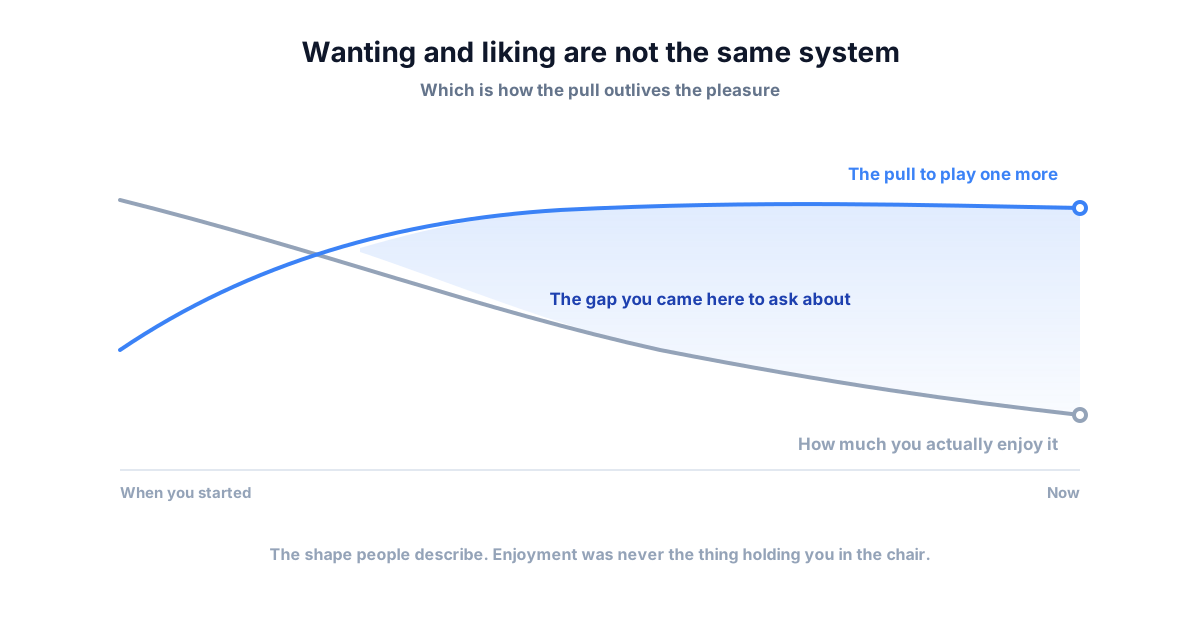
You loaded up the game you have played for years, sat there for three hours, and felt almost nothing. Not bad exactly. Just flat. Then you did the same thing the following night. That second part is the one worth explaining, and it is the part almost nobody explains.
There are two standard answers to this and both are comfortable. The first is that games got worse, which puts the cause safely outside you. The second is that you grew up and your taste moved on, which is gentle and sometimes true. Neither is completely wrong. Neither accounts for the strange bit, which is that the hours did not go anywhere.
The question has a false assumption buried in it
When you type why are games not fun anymore into a search bar, you are carrying an assumption you probably have not examined: that enjoyment is what was keeping you in the chair. It is a reasonable thing to assume. It is also, for a lot of people reading this, not what has been happening for quite a long time.
Wanting and liking are not the same system
The most useful research here is not about games at all. Kent Berridge and Morten Kringelbach, reviewing decades of work on how reward actually operates, describe two separable systems rather than one. Wanting, the pull toward a reward, is produced by a large and widely distributed network. Liking, the pleasure you get when the reward actually arrives, is generated by a much smaller set of what they call hedonic hotspots.
The two normally travel together, which is why we treat them as one thing in ordinary speech. They do not have to. A big, robust wanting system and a small, fragile liking system can come apart, and when they do you get the exact experience you came here to ask about: a strong pull toward something you are not especially enjoying.
So the sentence that has been bothering you, I do not really enjoy it and I still play every day, is not a contradiction and it is not evidence that something is wrong with you. It is the predictable output of a system where the pull and the pleasure are handled separately, and only one of them has been getting trained for the last several years.
There is a consequence to that worth sitting with for a second. If some part of you has been quietly waiting to stop until you stopped enjoying it, that day has already been and gone. It arrived at some point you cannot name, and nothing happened. Enjoyment was never the brake.
If you were waiting for the fun to run out before you stopped, it already has. That is the thing you came here to ask about.
The part where the games genuinely did change
In fairness to the games got worse camp, something real did change. It is just more specific, and better documented, than nostalgia usually allows.
In 1999, Edward Deci, Richard Koestner and Richard Ryan published a meta-analysis of 128 experiments on what happens when you attach an expected, tangible reward to something people were already doing for its own sake. The reward reliably reduced how much they wanted to do it for its own sake afterwards. The effects were moderate rather than enormous, but they held across the whole set.
Now look at what has been bolted onto games over the last decade or so. Daily quests. Login streaks. Weekly challenges. Battle passes that expire. Seasonal ranks that wipe. Every one of those is an expected, tangible, schedule-driven reward attached to an activity you originally did because you liked it.
That is not a theoretical concern. In 2022, Julian Frommel and Regan Mandryk surveyed 231 players about these exact reward systems and found the experience genuinely split. Some players found them motivating. Others described them as a source of missing-out anxiety, or plainly as an obligation and a chore. Playing in order to collect the rewards, rather than because you wanted to play, went with more externally driven motivation and with a state the researchers describe as having no real motivation left at all.
That is the shape of what happened to you. Nobody took the fun out. They added a schedule on top of it, and a schedule quietly converts a thing you chose into a thing you owe. It also explains why this bites hardest in the game you play most, which is exactly the one you would expect to enjoy the most.
Why a different game does not fix it
The advice you will find everywhere is to try a new genre. It does work, for about two weeks, and then it stops working, and most people read that as proof that the problem is worse than they thought.
What is actually happening is simpler. Novelty is an input to wanting, not to liking. A new game hands you a fresh, unexhausted pull, which feels like enthusiasm returning. Then the pull settles back to roughly where the last one left it, because the thing that changed was never really the game.
This is also the mechanism behind the backlog. You buy the thing, feel the spike at the store page and again on the download bar, play four hours and stop. If buying games were the fix, the forty unplayed ones already in your library would have fixed it. What you are chasing is not a game, it is a state: no obligations, no schedule, plenty of unclaimed time, and a tolerance you had not built up yet. Only one of those four is available for purchase.
Sometimes you have simply outgrown it
Now the honest branch, because not everything is a problem waiting to be solved. Some people reading this have had their taste move, which is a thing that happens with every hobby anyone has ever had, and there is no deeper explanation required.
There is a clean way to tell which one you are, and it is a single question. Are you playing less than you used to, or the same amount?
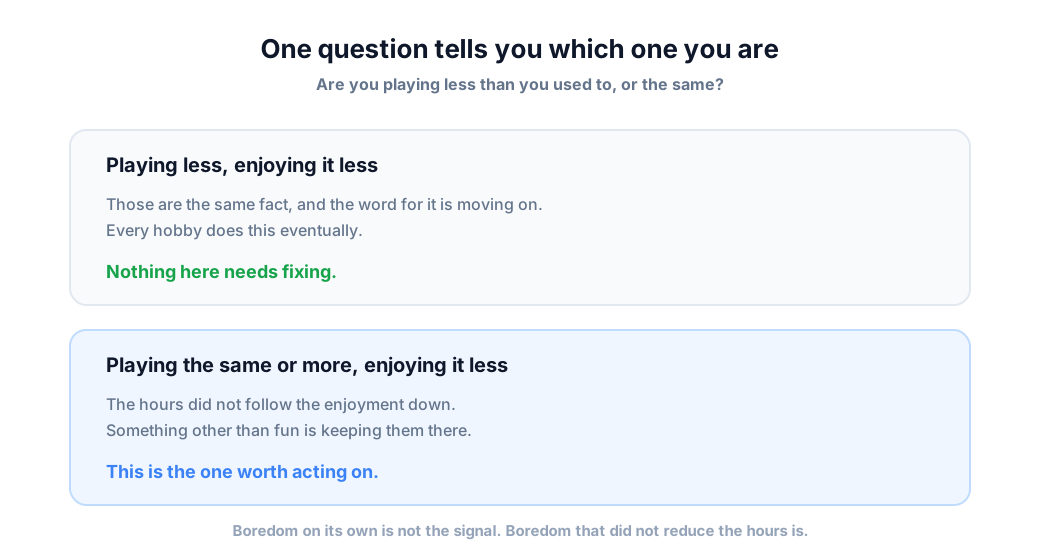
If you are playing less and enjoying it less, those are the same fact described twice, and the word for it is moving on. It does not need a plan. The only real mistake available to you there is treating an ordinary change of taste as evidence that something is wrong with you.
If you are playing the same amount or more while enjoying it less, that is a different situation and it is the one this article is really about. The hours did not follow the enjoyment down. Something other than fun is holding them in place, and it is worth knowing what, which is roughly the question we worked through in how many hours of gaming is too much.
What actually helps
- Stop waiting for enjoyment to make the decision for you. It already stopped and it did not stop you, so it is not going to arrive later as a signal. Whatever you decide here, you will have to decide on purpose.
- Skip the dailies for one week, before you change anything else. Not the game, just the schedule. If a week of ignoring the quests feels like nothing, the rewards were never the problem. If it produces a genuine flicker of anxiety, you have learned more in seven days than any amount of thinking about it would have told you.
- Take a short break instead of switching games. Switching resets novelty, which was never the part that was broken. A break is the thing that actually lowers the tolerance you have built up.
- Ask what you would play if nothing expired. No season, no streak, no battle pass, nobody waiting. If a clear answer comes back, your problem is the schedule rather than the medium. If nothing comes back at all, that is worth knowing plainly rather than testing it against another twenty hours.
- Work out which need it was actually meeting, because that is what will need somewhere else to go if you do step back.
On that third point, a short clean break has better evidence behind it than most of the advice in this area, and it is not the same thing as quitting forever. We went through what the research actually supports in how to play video games in moderation. And on the last point, the three needs games tend to be meeting, and how to tell which one is yours, are set out in what to do instead of gaming.
One more thing worth naming. If the flatness is not really about games, and things you used to like across the board have gone quiet too, then this article is aimed at the wrong problem and no amount of adjusting your quest log will reach it. That is worth saying to someone you trust rather than working out alone. If it is specific to gaming, though, it is an ordinary situation with an ordinary explanation, and the pull you are still feeling has a design behind it that we pulled apart in why competitive games are engineered to keep you hooked.
Gaming Reset is built for the version of this where the hours stayed and the enjoyment did not. Your own answers about what you play and what you want back become one small step a day, with the tracking handled for you, so the decision is not left to a version of you sitting in front of the game at eleven at night feeling nothing much either way.
The honest summary is that you probably have not lost your ability to enjoy things, and games probably have not been ruined for you permanently. You have a well-trained pull, a schedule that turned a hobby into a set of obligations, and a tolerance built over years. None of those are fun, and none of them are what you were promised when you started playing. It is worth finding out what is under there, and the only way to find out is to take the schedule away for long enough to see.
Frequently asked questions
Why are video games not fun anymore?
Usually a combination of three things rather than one. Tolerance builds over years of play, so the same game delivers less than it used to. Modern progression systems add expected, schedule-driven rewards on top of an activity you originally chose freely, and a large body of research shows that reliably reduces motivation to do something for its own sake. And in some cases your taste has genuinely moved on, which is normal and needs no fixing.
Why do I keep playing games I do not enjoy?
Because wanting and liking are handled by different systems. Research on how reward works describes wanting as a large, widely distributed system and liking as a much smaller one, and the two can come apart. That means a strong pull toward something you get little pleasure from is not a contradiction. It is what you would expect after years of training one system and not the other.
Is it normal to lose interest in gaming as you get older?
Yes, and it is worth separating from the other thing. If you are playing less and enjoying it less, those are the same fact and the word for it is moving on. Every hobby does this eventually. The situation worth paying attention to is playing the same amount or more while enjoying it less, because that means the hours are being held in place by something other than enjoyment.
Do daily quests and battle passes ruin games?
For some players, yes. A 2022 survey of 231 players found the experience genuinely split: some found engagement rewards motivating, while others described them as an obligation, a chore, or a source of missing-out anxiety. Playing to collect rewards rather than because you wanted to play was linked to more externally driven motivation. A useful test is to skip the dailies for one week and see whether it feels like relief or like anxiety.
Will taking a break make games fun again?
Often it helps more than switching games does, because a break lowers built-up tolerance while a new game only supplies novelty, which fades in a couple of weeks. A short break is also better supported by evidence than most advice in this area, and it is not the same as quitting permanently. What a break cannot do is restore enjoyment to a game whose appeal was mostly its reward schedule.
Should I be worried that games are boring me?
Boredom on its own is not a warning sign, and treating an ordinary change of taste as a problem does more harm than good. The thing worth noticing is a gap: enjoyment falling while the hours stay the same. And if the flatness is not specific to games, and things you used to like generally have gone quiet, that is worth talking about with someone you trust rather than solving through your gaming habits.
Ready to break the loop?
A simple daily plan built around how these hooks actually work, tracked in one app on web and mobile. Start free for 3 days.
Start free, 3 days →